


The Legacy of Rome and Charlemagne: The Translatio Imperii of Frederick Barbarossa
- EPOCH

- Jun 1
- 10 min read
Toby Bendle | Cardiff University
From the empire-wide messaging in his minting, to the private dialogue, both penned and subliminal through his iconography, Frederick Barbarossa stood as both one of the greatest Hellenophiles following Hadrian and is among the most propagandising rulers in European history. Rome did not simply die in 410 AD following the Visigoth sack of Rome. A landmark imperial superpower throughout history, the continuation of the empire lived through future empires in the Holy Roman Empire and the Byzantine Empire. In its most fundamental and understandable definition, Translatio Imperii (Translatio) is the concept of the transference and reign of one empire into a later one. One can think of Troy – the celebrated home of Hector and Priam – and how the Romans pledged themselves as Trojan descendants, and how various Holy Roman Emperors (HRE) claimed themselves as contemporary Romans and Trojans. This was all done to legitimise the succeeding empire; to transfer the imperial identity from one legendary and mostly successful empire – in this case, the Romans and Byzantines – onto another: the Holy Roman Empire.

The moniker of the classicist medieval monarch traditionally belongs to Frederick II, Barbarossa’s grandson and future Holy Roman emperor. From his commission of classical-motif cameos, education in antiquity, and his military victory parades resembling those of ancient Roman emperors, Frederick was undeniably the greatest Hellenophile post Hadrian. However, his grandfather Barbarossa associated himself with the ancients to a significant degree. Emperor Barbarossa (Redbeard) instigated a third crusade, expanded the empire, led a charge in new learning, and challenged German papal power. Graham Loud, in his biography of Barbarossa, goes as far as to proclaim him as one of “the last two great medieval emperors” alongside Frederick II. Frederick Barbarossa was an emperor who himself developed an interest in the imperial past and well-established former empires, with key evidence of translatio being used throughout his reign.
Referring back to prior empires and cultures was a common tradition for medieval kings as it established the continuation of a legendary empire and provided both stability and a rich history. Civilisations such as ancient Rome were key identities that were clung onto. Barbarossa capitalised on this translatio when addressing the Byzantine Emperor Manuel I Komnenos; he made a deliberate point in styling himself as “Romanorum Imperator”:
Fridericus divina favente clementia inclitus trimphator, Romanorum imperator, a Deo coronatus, sublimis, in Christo fidelis, magnus, pacificus, gloriosus, cesar, Grecorum moderator et semper augustus nobili et illustri regi Grecorum et imperatori, Emanueli, dilecto fratri suo, salutem et fraternę dilectionis affectum.
Frederick, by divine favour and clemency, the illustrious victor, emperor of the Romans, crowned by God, sublime, faithful in Christ, great, peaceful, glorious, Caesar, ruler of the Greeks, and ever august, to the noble and illustrious king and emperor of the Greeks, Emmanuel, his beloved brother, greetings and brotherly affection.
(Frederick Barbarossa to Emperor Manuel I Komnenos following the Byzantine defeat at Myriokephalon, 1176)
Barbarossa wanted to present this Romanised image of himself to the highest powers in Europe; articulating that the continuation of the Roman Empire lived through him. It is no surprise as to why Godfrey of Viterbo, a clergyman of Barbarossa and his personal chronicler, and Otto of Freising, the bishop of Friesing and another of the emperor’s commissioned chroniclers , would construct genealogical connections between Barbarossa and the ancient emperors, and a biography of the emperor follows the style of Vergil’s Aeneid. This is important within itself as the Aeneid places the Trojan protagonist Aeneas as a potential founder of Rome, a tale that ties the legacy of Troy to the later Roman Empire, with Barbarossa acting as a contemporary mirror-image to these mythical figures. Barbarossa displays his awareness of translatio and his imperial identity very clearly, with his burning desire to be considered in the same station as these figures.


Barbarossa took it upon himself to display his ‘Roman heritage’ to the masses through his coinage . His imperial coat of arms can be considered as a medieval descendant of the aquila, the eagle standard carried by legionaries and symbolic of Roman military might. Barbarossa’s fondness for the symbol was more intense than his predecessors; it appeared frequently on his coats of arms, coins, and on his imperial banner. Such coinage highlights Barbarossa’s intense desire to assimilate the imperial identity of the ancient Romans into his reign. It can be regarded as Barbarossa’s own attempt to portray himself as part of the Medieval-Roman lineage alongside Constantine, Otto III, and Charlemagne through the most public means. There was a certain awkwardness with following a pagan tradition in a highly Christian time. Although it was done by the likes of Charlemagne and Frederick II with how they both modelled themselves after Roman emperors or implemented notable Roman features, they twisted this imperial imagery to fit their kingship, as a way of transferring all the power and rights of the ancient sovereign to the medieval ruler, and blurring the distinction between the past and present. Medieval rulers could not brazenly spread Pagan-inspired insignias throughout their empires, as this would surely upset a widely Christian empire. Therefore, to invoke Translatio, a monarch needed to carry out the process delicately.
Displaying the imagery of kingship through Roman-inspired motifs was not just a public affair. Arguably, Barbarossa’s most distinguished depiction is the Cappenberg Head: An ornate golden portrait bust, a gift given to his godfather, which would later be used as a reliquary at Cappenberg Abbey. The physical manifestation of Barbarossa’s ideology, the bust was a testament to Frederick’s interest in the imperial past and consolidating this to his own reign. Although the bust heavily features Christian iconography, the head itself features key Roman traits. One can see stark similarities between the Cappenberg Head and the busts of ancient Roman emperors: the curled and wavy hair, the famous Roman nose, the purple knot representative of Roman mantles, with the colour expressing decadence and the toga being a military victory garment. There is clear evidence of a Roman influence in Barbarossa’s imagery. From private gifts such as the bust, to family and letters to fellow sovereigns, to broadcasting his imperial image across his empire, the role of the translatio regarding the ancient Romans played a significant role for the medieval “Caesar.”


The Byzantine translatio is an interesting concept when it comes to the reign of Frederick Barbarossa. Historically, Barbarossa and the Byzantine Empire had a complex relationship, involving cooperation and hegemony. From one harmonious extreme such as Isaac II Angelos allowing Barbarossa’s forces to march through Byzantine territory during the Second Crusade, to more tumultuous extremes including Frederick denying familial alliance with Manuel I Komnenos by refusing a Byzantine bride, there was never established harmony between the two titans. Despite that, it would be through the Byzantine-HRE feud that Barbarossa would implement in his reign and status as the true emperor.
The aforementioned conflict with the Byzantine Empire and its emperors is one factor that stressed the importance of translatio in Barbarossa’s reign. While the rise of Roger of Sicily challenged both Barbarossa’s ego and his succession to the ancient emperors, the Byzantine claim to the imperial past was a greater enemy to triumph over. More relevant to this article is the competition over Roman lineage. Both the HRE and the Byzantines saw themselves as descendants of the ancient Roman Empire, and therefore the continuers of the imperial lineage, both seeking to utilise translatio as continuato imperii (“the continuation of the empire”).
The Byzantine Empire's relationship with its imperial past is a tricky affair, and a divisive scholarly topic. In one corner of the proverbial academic boxing ring, there was a necessary change in how an emperor was anointed that did not coincide with the ancient tradition, and Komnenos was active in distancing himself from Constantine's reign and elevating themselves above it. Although Constantine was famously reborn as the inaugural Christian Roman emperor, he still remained an icon of an aged paganistic past and there was a need to move onto the present. Whereas in the opposite corner, the prior dialogue between Barbarossa seems to suggest that the Byzantines were still holding onto their disputed status as “the true Roman emperors”, even if it was to spite an old bitter enemy in Barbarossa. In discourse with conflicting empires, the Byzantines had previously defended their Roman status with the argument of Constantine moving the Roman Empire capital to Constantinople, the city formerly known as Byzantium. The Byzantines too were keen to hark back to their roots, even if this meant reflecting on a time both, more pagan and out-of-date. This could be a contributing factor to the conflict between Barbarossa and his oldest rivals over the true Imperial Roman lineage, alongside the territorial and personal disputes they shared. It was the animosity with the Byzantines over the motif of translatio and continuatio that was so significant in Barbarossa’s reign, as this was the central contender for his title of successor of the Roman Empire.
One figure that challenged the Byzantine claim to Roman legitimacy was the Frankish king Charlemagne, the inaugural medieval Emperor of the Romans. Charlemagne was one of the most influential and legendary figures in medieval history. Born nearly four centuries prior to Barbarossa, he was recognised as the first emperor to rule from Western Europe after the fall of the Western Roman Empire. So great was his impact in Europe, until 1531, German kings and queens were still crowned in his sacred cathedral of Aachen. The Roman Empire was not the only empire that the German emperor had translatio of. Barbarossa additionally made a conscious effort to tie his own name to Charlemagne, akin to how other monarchs and sovereigns did so, and used Charlemagne’s influence in his own image as emperor to an incredibly significant extent.
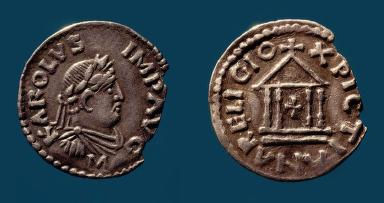
Circling back to the ancient Roman coins, Barbarossa was not the first monarch to mint imperial iconography in his coinage. Whilst we can liken Barbarossa’s coins to the likes of Constantine and others, we can additionally compare Barbarossa’s coins to Charlemagne’s own, and thus Charlemagne’s coin to the ancient Romans. Charlemagne held his own fascination with the imperial past, with one legend having the origin of the Aachen Cathedral being constructed atop the ruins of Roman baths commissioned by the brother of the infamous Nero. Even beyond his death, Charlemagne’s fascination with the imperial past surpassed him, with Suetonius’ Lives of the Twelve Caesars being a chief model of influence on Einhard's biography of Charlemagne: a piece of literature from an author tied closely to Charlemagne that was meticulously studied by Frederick Barbarossa. Although Barbarossa modelled himself after the ancient emperors because of their legendary history and prestige, Barbarossa additionally modelled himself after the Romans through title and image, simply because Charlemagne did so too — another example of Barbarossa modelling himself after the legendary emperor. It is worth noting that aside from translatio one would receive from the imperial past, the harkening to Constantine and Augustus could come from emulating Charlemagne’s own practices.
These two ancient Roman emperors stood as some of the most important in the Empire’s history: Constantine was the first openly Christian Roman emperor and moved the capital to Byzantium (later renamed Constantinople), and Augustus is often credited with the transition of the Roman Republic to the Empire. Constantine particularly mattered to Barbarossa due to his religious impact, his standing as one of the most influential Roman emperors, and his rivalling connection to Byzantium. Prior medieval rulers did fashionably model themselves in a Roman light. However, Barbarossa's relationship to Charlemagne was an exceptionally intense one. The History of the Pilgrims, an account of the expedition of Barbarossa in the Third Crusade, refers to Barbarossa as “a man of great experience imitating Charles in his valour”. This reputation alone highlights how Barbarossa idolised Charlemagne.
One of the more famous examples of Barbarossa’s attempts to emulate Charlemagne via translatio would be the canonisation of Charlemagne. Commenced in 1166, it served as part of the grander scheme to preserve Barbarossa's image and his reign. If we refer to the imperial past one more time, it is easy to observe this pattern of the protégé canonising, or rather deifying, the legendary predecessor. Augustus was part of the process of having his own predecessor Julius Caesar deified or made a god. One purpose for this was to provide a divine parentage for Augustus, essentially bolstering his own reign and prestige.
Whilst there likely was a high level of respect for Charlemagne to canonise him, this seems to be another part of Barbarossa's propagandist attempts to emulate a translatio of empires past, which appears to act as a continuatio of Saint Charlemagne’s reign into his own, and immortalise himself in the same way Augustus did. Even if we look at the installation of the Barbarossaleuchter – a wonderfully ornate chandelier in Aachen Cathedral commissioned by Barbarossa – it was all part of the plan of Charlemagne’s most zealous imitator to legitimise his own image as emperor through Charlemagne’s legacy.

Frederick Barbarossa showcases how significant the motif of translatio imperii was to his reign. Utilising it in a comparable propagandist way, it is clear to see his concern with his image as monarch and how his reign was cemented. From constructing an image reminiscent of the legendary Charlemagne and emperors of old, to clashing with the Byzantines over the legitimacy of descent from the imperial past and forcing his name in with Charlemagne’s legacy, translatio imperii played a key role in the reign of Frederick Barbarossa.
Further Reading:
Barber, Malcolm, and Keith Bate, Letters from the East: Crusaders, Pilgrims and Settlers in the 12th-13th Centuries, (Ashgate, 2010).
Purkis, William. J, and Matthew Gabriele, The Charlemagne Legend in Medieval Latin Texts, (D.S. Brewer, 2006).
Sulovsky, Vedran, Making the Holy Roman Empire Holy: Frederick Barbarossa, Saint Charlemagne and the sacrum imperium, (Cambridge University Press, 2024).
Freed, John, Frederick Barbarossa: The Prince and the Myth, (Yale University Press, 2016).
Loud, G.A., Frederick Barbarossa, (Reaktion Books, 2025)
Toby Bendle is a recent Cardiff University master's graduate in History, having previously completed an Ancient History BA with a year abroad in Canada. With an interest in the ancient past, Toby conducts research on topics such as Mediterranean religion, pankration, the Wild Man stock character, and translatio imperii.


