


Early Medieval Aquitaine and Carolingian Dynastic Drama

Eddie Meehan | University of Liverpool
Snow closed over the trail almost as soon as Pippin fled. The winter of late 831 was, as Louis the Pious’ biographer, known as the Astronomer, put it, ‘very harsh and inclement’, and the imperial army could not find the king’s son anywhere. Beyond reach, Pippin raised an army in Aquitaine while his father’s soldiers were left cold and confused. For the Astronomer, there was only one explanation. This was the work of the devil, ‘the enemy of humankind and of peace’, who had set father against son. Such a rupture within the family of Charlemagne threatened war, and with it the fragile but crucial bond between the Carolingian empire and God.

It had not always been like this. Charlemagne, the family patriarch, had ruled much of western Europe until 814, and had passed this realm, along with the title of emperor, to his only surviving son Louis the Pious. In 817, Louis set out his plan for the partition of his inheritance among his three sons. Lothar, the eldest, received much of the heartlands in modern-day Belgium, the Netherlands, eastern France, and western Germany, alongside Italy and the title of emperor. Louis, the youngest, received Bavaria. Pippin, the middle son, was handed Aquitaine. All three sons had names that marked them out as future kings. Pippin, for instance, shared his name with his grandfather and the first Carolingian King of the Franks, Pippin III.

What Aquitaine even was is not clear. It was a kingdom, to be sure, on a par with any other in the Carolingian empire. However, Louis’ partition of his empire seems to have forged Aquitaine out of a series of smaller parts. Louis himself had ruled Aquitaine under his father Charlemagne, and in Charlemagne’s similar division blueprint, the old emperor explained what exactly Aquitaine was: an assemblage of ‘Aquitainia’, ‘Vasconia’, ‘Provincia’, and ‘Septimania’. Septimania, for example, appears in our sources as the land of the Goths, while Vasconia is that of the Gascons (Basques) on the French side of the Pyrenees. Such a mixture of peoples and identities in a single kingdom was not unusual for early medieval Europe. In fact, Carolingian rulers had no concept of our ‘nation-state’. Instead, governing multiple peoples was a sign of great authority.
In 822, there was a decisive shift in the pair’s relationship. Five years after Pippin assumed the royal title, he married Ingiltrude. Ingiltrude was from a powerful family in the Carolingian world. Her father, Count Theotbert of Madrie, was related to the Carolingian dynasty and held a powerful position as count of Madrie, a region in modern-day Normandy, northern France. Our sources, such as the Royal Frankish Annals, present this as Louis’ idea, with him deciding who and when his son would marry. Yet this also marked Pippin’s political maturity.

Marriage, for Carolingians, was a public occasion in which much of the realm’s political community would gather in one place. Pippin and Ingiltrude’s wedding took place after a major assembly, a gathering of the political and spiritual elite of the Carolingian world, at Attigny in 822.
After their wedding, Ingiltrude and Pippin headed for Aquitaine. A Carolingian king and queen, once married, formed an independent royal household, residing in what was sometimes described as a ‘sacred palace’ (sacrum palatium). Palaces were moral, as well as political, centres of Carolingian realms. Carolingian kings and queens held court at palaces, where judicial and legal procedures could occur, as well as broader gatherings of notables from across the realm. Pippin and Ingiltrude seem to have preferred rural palaces. One poet, Ermoldus Nigellus, described Pippin as particularly fond of hunting, an activity which drew lay elite men together and forged a shared masculine identity. Ermold called on the king to ‘[keep] one day for hunting with weapons, another day…for more useful things’, a piece of advice implying Pippin took his love of hunting too far and neglected his royal duties.

Around the same time as Pippin’s coronation, Louis minted a small group of coins bearing his son’s name and new royal title. Minting coinage signified power in early medieval Europe, as only the senior ruler issued coins, and Louis kept hold of this privilege. Eight coins of Pippin survive, all of which bear a depiction of a temple that scholars can date to around 818, just after Pippin received the royal title. This temple evoked classical Roman architecture, with pillars and colonnades, but also the Biblical Temple of Solomon. Louis’ ordering of coins cemented Pippin’s legitimacy as the new king, but also underlined his position as the family patriarch. Pippin could not issue coins without his father’s approval, so this crucial sign of kingship remained in his father’s hands.

It is around this time that Louis seems to have taken the training wheels off Pippin’s kingship. Mentions of the emperor decline in Pippin’s legal documents. Meanwhile, a group of advisers close to Louis left Pippin’s court, indicating that Pippin now chose his own counsellors. For Louis, organising the marriage between Ingiltrude and Pippin seems to have signalled that both were now fully-fledged Carolingian rulers, established in their kingdom. Both of their sons, Pippin and Carloman, took names with a Frankish royal pedigree, demonstrating their parents’ intention for them to be rulers. The Carolingian future of Aquitaine seemed to be sealed.
A string of unfortunate events in the late 820s put the pair’s relationship under pressure. An Umayyad army, led by Abū Marwān ‘Ubayd Allāh, threatened Carolingian-held Barcelona in 827 and into 828. The Umayyad caliph and ruler of Iberia, ‘Abd al-Raḥmān, had sent the army in support of a rebellion against the Carolingians on the frontier between the two realms. Louis sent Bernard of Septimania, a powerful noble with interests close to the region, to deal with the crisis; he later sent Pippin, alongside two other counts, Hugh and Matfrid, to reinforce Bernard. Yet Pippin and his allies arrived too late to make a difference. The Umayyad army had already pillaged and left Carolingian territory, in a manoeuvre characteristic of early medieval warfare.
For early medieval kings, military setbacks signalled divine displeasure with their sovereignty, thereby posing a threat to their legitimacy and so too their kingdom. Around the same time, a series of bad weather events and therefore famines hit the Carolingian realm, and the emperor summoned a series of church councils to examine where things had gone so wrong. Alongside this spiritual introspection, Louis dismissed Hugh and Matfrid from their positions, promoting Bernard in their place to a position of power at court. Yet Hugh’s father-in-law was Louis’ eldest son, Lothar. Pippin, perhaps chafing at a loss of paternal faith, seems to have taken the lead in stirring up a rebellion headed up by himself and his elder brother. They took aim at the newly influential Bernard and the empress Judith, Louis’ second wife and mother of Charles the Bald.
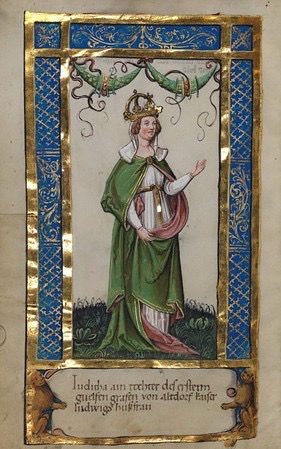
The rebels accused Bernard and Judith of adultery, framing their charges in moralising and misogynistic terms. Archbishop Agobard of Lyon led this charge, alleging that Judith had manipulated Louis to hide her infidelity, even implying she had used magic to achieve this goal. The archbishop called her ‘the author of evil’, although stopped just short of openly accusing the empress of witchcraft. For a Carolingian audience, these claims shook the moral foundations of the realm. If that was not enough, they claimed the pair had plotted to remove the emperor Louis and install Bernard in his place. The rebels demanded Louis send Judith to a monastery and remove Bernard from power, a set of demands that would have been unthinkable a few years before. These accusations likely had both Bernard and Judith fearing for their lives.
One of the Carolingian world’s foremost bishops, Jonas of Orléans, took it upon himself to warn Pippin of the dangers of this rebellious course of action. In a letter dedicating a handbook of advice for kings, Jonas cautioned the King of Aquitaine to remember his duties as a king and as a son. If Pippin heeded this advice, Jonas promised, he would receive the benefits of peace and harmony, a stable and prosperous kingdom. Meanwhile, if Pippin ignored Jonas’ counsel, the realm would be hit by famines, bad weather and enemy invasions.
Jonas’s handwringing took on a particularly prophetic air after 832. While Pippin was briefly reconciled with his father in 831, bought off with promises of a larger kingdom and the removal of Bernard from his position at court, this did not last. Bernard, seemingly not content with being at the centre of one almost-civil war, set about stirring up a second. Changing sides, the Septimanian noble encouraged Pippin to revolt against his father, setting into motion a series of events which would lead to the brief deposition of Louis in 833.
As we saw earlier, Pippin escaped from his father’s custody in the winter of 831 into early 832, and he was presumably supported by much of the Aquitainian nobility. Much of this support must have arisen from confusion as to what Louis’ plans actually were. The emperor had, by this point, issued several different and conflicting plans for the succession. The rebellious sons and Louis met near Colmar, in Alsace, in modern-day France, where Louis’ support seemingly vanished into thin air. After this desertion, Pippin, Lothar, and Louis the German forced their father to do penance at Soissons. Louis the Pious gave up his sword at the altar at St-Medard at Soissons, a symbolic removal of his imperial authority. Such events were public, and their audiences did not simply watch but interpreted them on their own terms.
This penance was quickly reinterpreted as an aberration, a wrong in itself that required penitential activity. Pippin and Louis the German seem to have quickly grown dissatisfied with their elder brother’s decisions as the new emperor, and they allied to restore their father to the throne. After this volte-face, it seems as if Pippin and Louis and Judith were reconciled. Pippin’s legal documents begin to reference his father’s authority and instructions again, perhaps a sign of both parties trying to make the rapprochement stick. The rebellions were certainly not forgotten; it is hard to imagine Judith being particularly keen to forgive the rebels. For example, Agobard, the vitriolic enemy of Judith, spent five years in exile until a general amnesty in 839. Agobard was an extreme example, a convenient scapegoat, but clearly Louis did not want to forgive all the rebels.
Yet Louis and Pippin sought to show themselves as reconciled. Pippin’s royal acts now refer to ‘our father Louis’ admonition’ as guiding his rulership of Aquitaine. Unlike Lothar and Louis the German, Pippin did not rebel again but remained in Aquitaine until his death in 838. For both Pippin and Louis, rulership was not only a matter of family politics but also of Christian responsibility. The emphasis on familial harmony we see after a crisis, while it might seem like cynical propaganda, reflects this concern with spiritual harmony, the same concern that appeared in Jonas’s text. For Pippin, as for all Carolingians, to rule was to hold a responsibility to God to correct wrongs and ensure the salvation of all those in the realm.
Family drama and spiritual duties were therefore inseparable. If a Carolingian ruler was a bad son or a bad father, this had divine implications. Even when so much had gone wrong, Carolingian rulers had to try and pull the political and social order back on track.
Further Reading
Stuart Airlie, Making and Unmaking the Carolingians, 751-888 (Bloomsbury Academic, 2020).
Matthew Gabriele and David M. Perry, Oathbreakers: The War of Brothers that Shattered an Empire and Made Medieval Europe (HarperCollins, 2024) .
Mayke de Jong, The penitential state: authority and atonement in the age of Louis the Pious (Cambridge University Press, 2011).
Janet L. Nelson, King and Emperor: A New Life of Charlemagne (Allen Lane, 2019).
Eddie Meehan is an early medieval historian, who completed his PhD at the University of Liverpool. His research currently focuses on the intellectual culture of the Carolingian world, using digital humanities methods. The work undertaken for this article also resulted in an academic journal article: Eddie Meehan, ‘The rulership of Pippin I of Aquitaine’, Early Medieval Europe, 33. 4 (2025), https://doi.org/10.1111/emed.12784 (available Open Access, CC-BY license).


