


Beyond the ‘Shiny Bits’: Reinterpreting an Iron Age Mass Grave at Gomolava, Serbia

Updated: Jun 4
Dr. Linda Fibiger | University of Edinburgh

EPOCH Editors Aimée Wilkinson and Josh Coulthard sat down with Dr. Linda Fibiger, Senior Lecturer in Human Osteoarchaeology at the University of Edinburgh, to discuss her recently published article about her finds at the mass grave at Gomolava, on the Sava River in Vojvodina, Serbia. Fibiger’s osteoarchaeological evidence uncovered a more violent and intentional scene in the Iron Age site than initially expected, revealing the victims to be predominantly women and children, and shining new light on the various goods buried alongside them. Throughout this interview, she shares her experience with the site and working on this interdisciplinary project, as well as tackling issues regarding how we interact with burial sites and human remains, as well as how those looking to enter the field of osteoarchaeology may approach this site and others like it.
Josh: The site was originally excavated in the 1970s. What motivated you to revisit and reassess it?
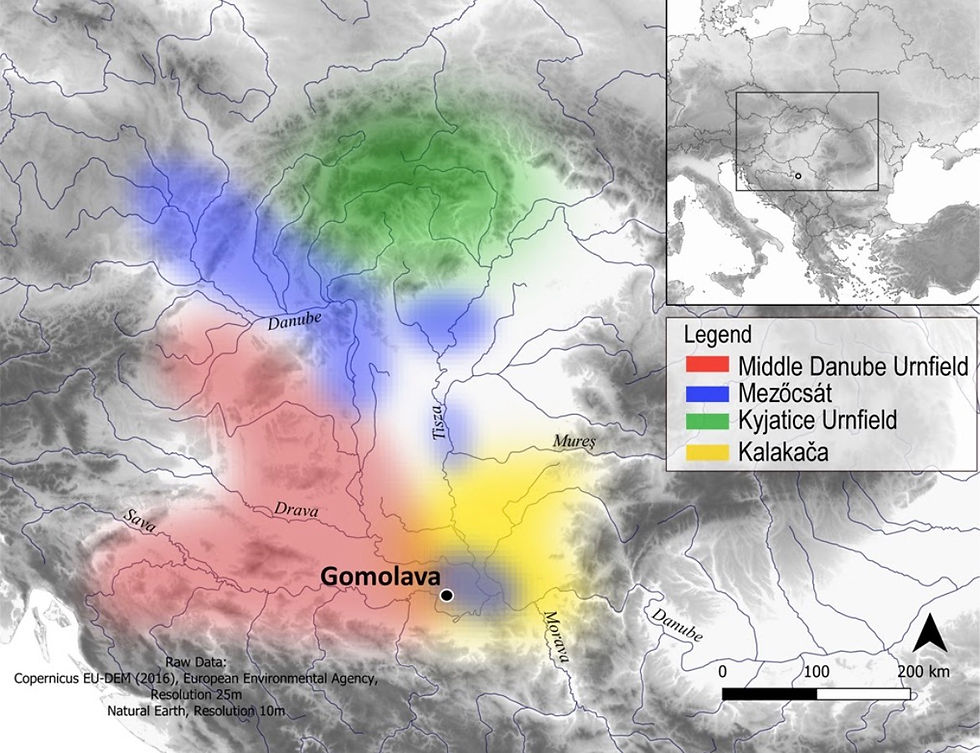
Linda: This research was part of a larger research project called ‘The Fall of 1200 BC’, which was led by Dr. Barry Malloy from University College Dublin. The project investigates what happened during the Late Bronze Age (around 1200 BC) and its impact on populations in the Balkans and Greece. The project included bio-archaeological work, biomolecular work, settlement analysis, and artefactual analysis. While Gomolava dates to the Early Iron Age (ca. 1000–450 BC), it was included to examine the long-term aftereffects of that period.
The site has been known since the 1970s, and while other osteologists looked at it in the 70s and the ‘90s for various questions, it was clear that we didn't really know what had happened there, or what those individuals died of. The idea of a pandemic had been mooted, so we went back to it for ‘The Fall of 1200 BC’ to look at certain health indicators. Trauma was also one of the questions we had; then we found all this evidence for perimortem trauma. So, it was quite unexpected, I would say. Within a couple of days of starting on the site, I was back to Barry saying, ‘Oh my God, this is definitely not a pandemic, something else has happened here’.
Aimée: Your research on conflict spans across Europe and the Mediterranean. What is the significance of this site compared to others you have studied?
Linda: A lot of my previous work has been earlier, looking at the Neolithic (ca. 4500–2500 BCE), where I focus mostly on violence at the population level. I look at the 'normal' burial record, whatever normal is in the Neolithic, rather than these high-profile mass grave sites. So, moving into the Bronze Age (ca. 2500–1000 BCE) was a new and interesting period for me to explore.
In terms of why the site is so special, mass graves are very particular sites, and in this case, it’s also the scale. There are at least seventy-seven individuals. There was actually another mass grave found at the site in the 1950s, but unfortunately, they only briefly looked at it. The records say they reburied it, but the archaeologist who researched this suspects they actually put the bones back into the river, since the site was right next to it and the water had already eroded part of that first grave. They just did an assessment, kept the ‘shiny bits’, as archaeologists sometimes tended to do in those times, and didn’t keep the bones.

The scale and setup are interesting. It’s a site on the River Sava that saw settlement activity for thousands of years, so it was a very well-connected location. What’s truly interesting is the demography in the grave: it’s predominantly women and young individuals, especially girls. On top of that, you have this remarkable arrangement of grave goods packed into a very small space, which might have been a reused pit house. We’re not entirely sure, as the excavation records aren’t perfect for reconstruction, but even with so many individuals in a tight space, it’s a very curated, constructed place. They weren’t just chucked in; they were fitted in there.
You also have metal work in there, you have pottery, one of the first things that went into the grave was a cow, you also have evidence of animal meat within the grave, probably representing fifty to seventy individuals, and you have grain. You have all these other finds around it as well, which speaks of disposable wealth, both in terms of the finds but also in terms of the individuals. If we look at the mass grave sites from prehistory, quite often you get this argument that young women and often children are not as well represented in those graves because they would have probably been kept alive, either enslaved or taken away for procreational purposes, etc. So, in this case, that demographic is predominantly presented.

Aimée: How did you find the move into focusing on the Bronze Age?
Linda: That was quite interesting. I mean, I don't consider myself a prehistorian because I'm a bioarchaeologist. I've looked at remains all the way from the Neolithic to the post-medieval period. So, for me, it's more about the project and the questions. What was interesting about ‘The Fall of 1200 BC’ is that it was a truly interdisciplinary approach. That term is quite often used for projects, but it doesn't always pan out that way. As a bioarchaeologist, I've been on bigger projects before where people say, ‘Oh, yeah, we're going to be really interdisciplinary’, but it's really more about stitching different types of information together or the bioarchaeologist providing the colour of the dots on some graph for isotope analysis. So, this was really interesting because the project was very much question-driven, rather than going, ‘here we have the DNA’, ‘here we have isotopes’, ‘here we have bioarchaeology’; it was really about very particular questions and that also translated into how we approached trying to understand the site.
Also, in terms of the publication process, which is quite interesting because of the type of journal it was published in, which is fairly high profile, if you look at a lot of DNA papers that are out there, they lead with the DNA analysis, and then other things follow suit. So, for us, it was quite important to lead with the question and really try to understand who these individuals were and what happened to them. So, it wasn't all about the DNA; it was really about questions that we tried to answer with as much evidence as we could. So, that was really good. Also, having been on projects before where we did DNA analysis, I was like ‘yeah, yeah, DNA is going to tell us these people were related, big deal’. This was the first time I was actually quite surprised because it told us the opposite, that mostly they are not related at all or not closely related, at least biologically, because that's all we can talk about with DNA is biological relationships. How this panned out, you know, in terms of social relationships, is another question. But yeah, that was quite a surprise for me to those results. So, in a sense, it's not necessarily about the period; it's about the question and also about the project set-up, which really was conducive to dialogue and trying to really understand the evidence rather than giving preference to any particular strand of evidence.
Josh: So, do you feel that we can balance the individual human stories of the victims with this broader scientific approach?
Linda: As a bioarchaeologist, what I do is I look at individuals and try to understand their life history. When you then try to translate that into application, it can be quite tricky because, as scholars, we’re to some extent restricted, especially in the more science-y approaches in archaeology, to a particular format. What we try to do in the article, and I fought very hard for having that reconstruction in there, is to give it a tangible kind of human aspect and when it came to how many illustrations we can have. I said that I really want it in there for that reason, to give it more immediacy than it would have if you showed a graph or a schematic drawing of traumatic injury distribution. It's easier when you do presentations, as you can weave individual case histories in. Overall, I hope that in the article we did bring across the brutality of the attack and the effect it would have had, not just in the moment it happened to those individuals, but on those who were affected by these particular events.
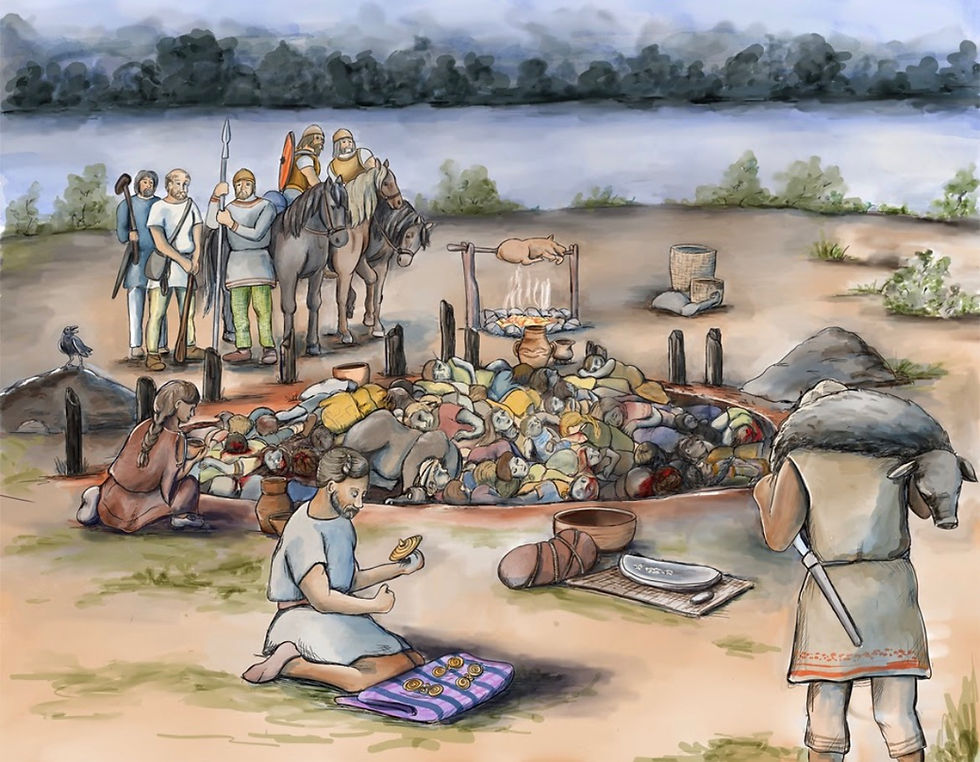
Aimée: From a historian's point of view, the diagrams made the topic much more approachable and digestible, allowing us to understand the scale better. While we can understand some of the specific DNA details, the article's narrative really helped introduce the topic and clarify what you were discussing. It was great!
Linda: Can I just say a lot of archaeologists don't really understand how DNA works! So that's also a problem. I think something we need to address within the discipline is how we frame it in a way that it's broadly understandable. You can't be an expert on everything, but I think it also leads to people going, ‘Oh, wow, DNA, it's always brilliant, and it's always right,’ because it's absolute scientific evidence, but it doesn't quite work out that way.
Aimée: Your analysis revealed that the victims were from different settlements; why is that significant, and what can that tell us about violence in the area and how this fits within the bigger picture of how these individuals were affected?
Linda: For a long time, people presumed warfare around this time was more small-scale or settlement-based. But now, sites like Gomolava, and even earlier Bronze Age sites like Tollense in Germany, challenge that. Tollense is a massive battlefield site with skeletal remains and weapons spread over a huge area; there is some discussion about what kind of site it is, but it’s clearly a large-scale violent event. It shows that people came, not from one locality, but from a wider area, suggesting that conflict during this period was much larger in scale, both in terms of numbers and geography.

Gomalava represents a substantial change from earlier mass graves, which were usually interpreted as village or settlement-based. The proportion of women and children in this grave is really unusual and tells us there was a shift in how violence was conducted. In previous mass graves, children and younger women were often missing, suggesting they were kept alive as slaves or because they had some sort of value. At Gomolava, I suppose we see that killing them also had 'value' because they held a wider social and economic importance. There is a message the perpetrators were trying to enforce.
It's quite interesting when we got to this first. As a woman working in archaeology, I see myself as fairly clued into issues of bias and balancing the picture, but I did the same thing that many people would do. You go, ‘Where are the men?’. And then I said, ‘That's completely the wrong question to ask. Why am I still conditioned to approach it like this?’, it's more about why they selected women and children. You can be aware of the present as well, where in current conflicts, women and children are quite often predominantly affected and selected for a particular reason to achieve a particular impact. That's not because they're soft targets, but because they hold a kind of social, economic and personal significance to the group they belong to.
Josh: In the article, you mentioned one of the few other sites where we see a large number of women and children buried like this is at Fin Cop hillfort in England (fourth century BCE). Why do you think we are only just now identifying these types of sites, and what does this pattern tell us about the nature of conflict during the Iron Age?
Linda: It's a good question, one could argue, as we often do, that there might be more; we haven't found them yet. The archaeological records we have are biased by where people excavate. Quite often, archaeology is driven by commercial developments, so you're excavating along motorways or housing developments. However, the site in England is also Iron Age, which suggests this period marks a shift in the nature of conflict and the strategies people employed to achieve their goals.
I'm not saying this is the first time this ever happened because there might be others out there, but it certainly marks a shift both in the scale of conflict and in the kind of strategies that are employed and who's directly affected. In the Neolithic, we see an increasing division of labour, and conflict became part of that. By the Bronze Age, you have the rise of the 'warrior' specialists whose specific job was to perpetrate violence. This was a significant change.
This shift means that when women were affected, it was within a new context. I’m not saying women were never actively involved in conflict; there are many examples throughout history where they were, but for the majority, men were more actively involved and better trained for it. So, when women found themselves in situations of fighting, they might not have been as well-prepared as a man would have been. But that is different from being a ‘soft’ or easy target. If you look at the division of labour in terms of childcare and rearing, women in conflict would have found themselves not just protecting themselves but trying to protect the younger individuals of the group as well. I think at that point in human history, there is a sea change, both in the scale of conflict and in the strategies employed, specifically, who the violence is directed at on a larger scale. I believe you would have had interpersonal violence where women were affected at any point in the past, but this is clearly something much larger, much more organised, and much more directed.
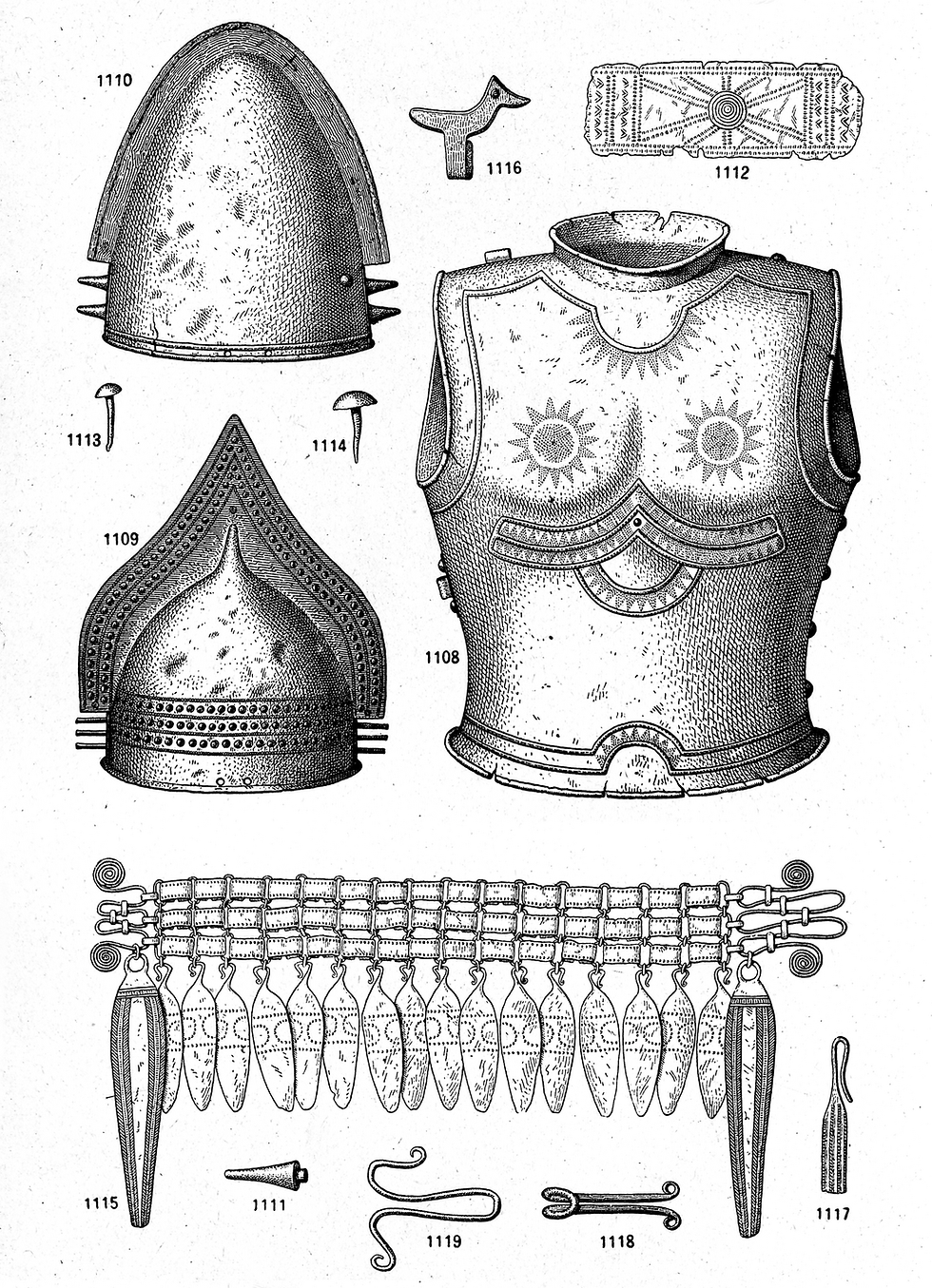
Aimée: You mentioned the significance of finding women and children buried with grave goods. Could you elaborate on why these finds, such as the animal remains, make this site so unique?
Linda: ‘Mass grave’ is a broad term that can describe different types of arrangements, from careful placement to people being carelessly thrown in. Here, even though it’s a tightly packed space, it is clearly and carefully arranged, and it presents a lot of wealth. These people weren't just dispatched, put into a hole, and covered over; this was creating something almost like a monumental site.
The memory of these events would have endured for years, potentially into the next generation. This amount of disposable wealth sends a sign to those who know the site. There might have been feasting there, which is what the meat joints could represent, or it was some sort of offering. But it is clearly someone saying, I can afford to do this, and this event and this place are important.
The narrative we constructed based on the evidence suggests a shift in power relations. But you can never say our narrative is the only one; we think it matches the evidence that we have. But ultimately, we don't know who buried them. What we do know is that there was importance given to this event. It's not an arbitrary collection of individuals, especially because they're not from one place; they're displaced from their place of origin, and all gathered at this one particular site.
I know I sound a bit woolly, but I also don't want to stretch the evidence too far, but we think what we set about the site makes sense in terms of the evidence we have.
Josh: Who do you think the audience for this site would have been?
Linda: I think both those affected by the death of these individuals and those who perpetrated the violence. I think it demonstrates power and dominance from the side of those who killed these individuals. For the families and settlements these people came from, it’s a clear message. In the article, we call this ‘genealogical disruption’; it’s such a significant event that it likely ended entire family lines.
Personally, I would see it as ‘don't step out of line because these are the consequences of your actions’. Furthermore, this general area was home to different cultural groups, different life ways, some more settled, some more mobile, and clearly this is kind of a flash point, and it all comes together at this site. Whether this resolves it in the longer term is another question.
Aimée: Could you go into a bit more detail about what from the finds is exciting and interesting to you in terms of looking at violence in that area, and more about the event?
Linda: I think the pattern is quite interesting because it's clearly not classic face-to-face conflict. Most people these days are right-handed. If we presume that's the same in the past, and you have close contact fighting and you hit somebody, especially in the head, you'd either hit the front or the left side. Whereas this is not the pattern we see here, a lot of the injuries are on the right side, on the back, or at the top. So, then you can also start thinking about attacker-victim constellations and how people were positioned in relation to each other. Injuries to the top might mean the individual wasn't standing up, or because we have a lot of young individuals, the perpetrator was taller, or maybe even in an elevated position, like on horseback.
Obviously, this is conjectural, but these are possible explanations. What's also interesting is that while most of the injuries are blunt force and probably close contact fighting injuries, we also have some evidence of projectiles, arrows, or spears with some of the injuries. We have post-cranial injuries, injuries to the pelvis, and injuries to the shoulder, and we also have one sharp force injury to an arm where somebody was probably holding up their arm to shield themselves.
Also, if you look at the size of the injuries, a lot of them are quite substantial. The majority are unhealed injuries, so they were related to the death event, but they're also really large. So, it's an uninhibited force rather than accidental killing. People have asked before, ‘do you think it's an execution?’ but it's not as if they lined them all up because the location of the injuries and the size aren't consistent enough to say they all got dispatched in the same way. But there was clearly uninhibited force involved; the intention was to kill all these individuals.
Josh: To return to a point from earlier: If not by blood, what sort of connections do you think the victims may have shared?
Linda: I presume their life ways would have connected them; we can't exclude that they weren't closely socially related just because they're not related genetically. With DNA, we can only talk about biological relationships, but just because there are no close biological relationships, we assume not all of them were closely socially related or even knew each other. But it's very hard to say. Also, graves are always constructed by those who stay behind. So even in terms of the finds that were buried with people, that wasn't their choice to have that in there.
Aimée: Is there anything else that you came across that shocked you, or that you found particularly interesting?
Linda: It's always quite affecting to work with human remains, but the large number of young individuals, it's particularly sad when somebody's life is cut short at such a young age.
On a personal note, while I was working on the remains, I went to see a friend of mine who was working in Kosovo. He’s a forensic anthropologist, and he was identifying individuals from the conflict there. When I went into his lab, he showed me the remains of a whole family who had been massacred. They all had gunshot wounds to the head, and there were three kids in that group as well.
It really brought home that nothing has changed over thousands of years. People find themselves in these situations and are unable to defend themselves. My role in this is to tell the story of these individuals because, whatever happened over the years, they got forgotten.
I think the events were remembered for quite a long time, but eventually they got forgotten until the grave was excavated. Even then, it wasn't realised that this was actually the result of violence. For me, it was quite interesting, quite important to highlight the story of those women and those kids that were buried there.

Josh: How can we engage with mass violence as an academic subject in an ethical way?
Linda: I say to my students it should never be about glorifying the violence. I think no matter what the topic that we're looking at as archaeologists or historians, it's important to make sure that it's not about a particular agenda, it’s about trying to see what kind of information the evidence provides and what narrative fits the evidence and never dehumanising those individuals. For bioarchaeologists, we deal with the remains of individuals all the time, but I think it's really important to make sure that translates into the narrative we're providing as well. That can be quite hard.
We talked about this earlier in the academic publication journal format, when these articles are successful and go into the public domain. We provided a folder for any press contacts we had of images they could use because I can't prevent it from happening, but I really don't want people using images of the grave and of actual human remains, especially once they enter the public domain. While those images are in the journal, that is more of a 'classroom' situation where people go specifically to study them. Once images go viral in online news outlets, they develop a life of their own.
Josh: How have you found the experience of communicating the research to a wider audience?
Linda: I find giving talks to the public quite interesting because you can get the most unexpected questions. And often they're quite insightful, actually, where you're going, ‘God I never thought of looking at it that way’.
Talking to the press was quite interesting as well, in all sorts of ways, in terms of how different people go about interviewing you, timelines, etc, depending on which newspaper. But I think it's really enjoyable. It also reminds you that generally in academia, the times when we could just publish our research article and be done with it are over.
We really, for all sorts of reasons, need to engage at a much wider level. I think it's interesting, there are so many different ways of doing this now to reach different audiences, which is quite exciting. We did a piece for The Conversation, which was quite interesting because you’re co-creating that with one of the editors, and it's all real-time with people editing and commenting. We also did some stuff on YouTube with Flint Dibble. That was completely different again. It's also interesting to see sometimes the online comments, which range from very interesting to - yeah, sometimes you need a thick skin. It's a bit like the academic review process when you try to publish an article and the reviewer isn't particularly pleasant about your work.
I think it's great. It's really exciting and it's also nice when you feel your research has relevance beyond your immediate peers and that it speaks to people, and people are engaging with it.
Ultimately, I believe it’s a good exercise, whether in speaking or writing, to express yourself in a way that appeals to a broader audience. Even in academic writing, people should be able to understand what you are saying, even if they aren't a specialist. If your work is so jargonised that nobody can grasp it, even within an academic context, that's no good.
Aimée: For early-career researchers engaging with this site, what new lines of inquiry does it encourage? What are the next steps for research in this area?
Linda: It’s interesting talking about this from an early career focus, as this was part of the PhD research of one of the co-authors of the article, Miren Iraeta-Orbegozo.
More generally, what’s next for the site? One thing, which brings us back to the ethical point of view, is that I only looked at the remains osteologically. Osteological analysis is non-destructive. During that process, I had to address how they had been stored since the 1970s. They were boxed in a way where you might have one individual, but when you try to lay them out, you find most of that person mixed with a pile of bones from others. Unless you are highly experienced in excavating these types of layers, it is incredibly difficult to separate the individuals, and I made sure I re-bagged them in a more organised fashion for long term curation.
But we only sampled a third of individuals for biomolecular analysis, and that was a conscious decision, as DNA analysis is destructive.
In terms of sampling methodology, we've already seen such a huge change in the last decade in terms of the sample size for DNA and even since we did it to now. It's interesting to think about what other techniques will develop that might be able to give us additional facets of information to fill out the narrative, and that's also a reason not to wholesale sample everything.
With regards to the early career aspect in particular, sometimes it’s about being in the right place at the right time. When I started as a bioarchaeologist after my master's, I worked freelance. One of the first sites I analysed as an osteologist was actually a mass grave. I happened to be on-site, having worked in field archaeology for years, and I was probably one of the cheapest options since I was already there. That is where my interest in conflict, violence, and mass graves developed from.
I think also, if you look at the history of the site, people said, ‘Oh yeah, it was probably a pandemic, or people died of a disease or something’. Never take the information that's already out there for granted, no matter who said what in the past. Just keep an open mind, keeping an open mind when you come to these projects is really, really important. Also, having a fresh pair of eyes or a different question to pose can really make the difference.

Josh: And finally, what advice would you give to those looking to move into studying osteoarchaeology?
Linda: Depending on where you operate, in the UK at least, you would want to have specialised master's level qualifications. I know some degrees have modules you can do or individual seminars as part of their undergraduate curriculum, but if you want to work with human remains in a professional capacity and in a detailed way, you really do need to complete a master's programme.
After that, it depends on whether you want to go the academic route or not. I worked for years in commercial archaeology after my master's, initially for a company and then as a freelance osteologist. That was actually professionally one of my most fun periods. All I did was analyse skeletons, excavate skeletons, go out to sites, advise people, and maybe do a bit of teaching.
If you want to go the academic route, a PhD is necessary these days. If this is something you want to do, you really have to go for it. Get the necessary experience beyond the master's, do excavations, and build up your network. That is the same for other parts of archaeology and history; having the degrees alone is not enough anymore.
Things like EPOCH, getting involved in extracurricular stuff, are really important too to broaden your skill set and your academic maturity. It shows that you are not just a ‘one-skill wonder’ but that you have a broad understanding of the discipline.
Dr. Linda Fibiger and her collaborators’ article ‘A large mass grave from the Early Iron Age indicated selective violence towards women and children in the Carpathian Basin’, published in Nature Human Behaviour, is available open-access here for more information on the site and their findings. We are grateful that Dr. Fibiger took the time to talk about her research and give us key insights into this fascinating project.
Dr Linda Fibiger is a Senior Lecturer in Human Osteoarchaeology at the University of Edinburgh and Programme Co-Director of the MSc in Human Osteoarchaeology. She has published widely on bioarchaeological perspectives on violence, conflict and gender, as well as experimental bioarchaeology, reconstruction of past lifeways and the promotion of professional standards, ethics and legislation in bioarchaeology. See her University of Edinburgh profile for more details on publications and current research.


