


Abolition and Commodity: Aphra Behn and the Black Body

Dr Isabel Gilbert | University of Worcester
During the era of the transatlantic trade in enslaved peoples, abolitionist writers and activists condemned the cruelty of the barbaric practice of slavery. Though these individuals offered myriad perspectives, coming from diverse communities and backgrounds, the cultural hegemony of white, European authority in colonial spaces often meant certain voices were heard more loudly and readily than others. Given centuries of scholarly endorsement to the pseudoscientific construct of racial hierarchy and biological difference, it was often the physical and tangible differences between people of certain races that became a focal point for the justification of exploitation and enslavement. Against a backdrop of large-scale transatlantic trade in enslaved people, renowned author Aphra Behn wrote her seminal work of prose, Oroonoko: or, the Royal Slave which has long been widely regarded as an abolitionist work.
Published in 1688, the novel centred on the character of Oroonoko: a prince and army general from the region of Coromantien, which is part of modern-day Ghana. In her first descriptions of this character, Behn draws on the literary motif and myth of the ‘noble savage’, depicting Oroonoko as a man in possession of an ‘extreme good and graceful mien, and all the civility of a well-bred great man.’ From this passage alone, one might assume Behn therefore recognised in Oroonoko a man who might be equal, if not superior, to her in terms of social standing. However, any assertion of greatness one could attribute to Oroonoko has already been tempered by this point, as Behn earlier asserts his education and grace come from ‘the care of a Frenchman of wit and learning’ in addition to the influence of English men who had traded near his home. It is the attributes which make Oroonoko more similar to a European that have rendered him palatable to Behn, and it is perhaps here that she seeks to persuade the reader of his value.

Behn then moves to descriptions of Oroonoko’s physical presence, noting his face ‘was not of that brown rusty black which most of his nation are’, replicating that age-old colonial custom of establishing hierarchies even within groups considered inherently subordinate. Here we can already see the way in which Behn sees Oroonoko’s humanity, not as part of an African nation of peoples, but instead through his supposed separation from them. She goes on to describe the colour of his skin as ‘ebony’ or ‘polished jet’ which again set Oroonoko apart from his fellow enslaved Africans given his proximity to valuable materials as opposed to rust which is universally considered to denote decay and uncleanliness. Interestingly, ebony was considered a highly prized hardwood, used in the creation of luxurious, decorative furniture during the seventeenth-century. Expensive to harvest and transport, this exotic and valuable material naturally symbolised wealth and sophistication for those who possessed it. The comparison between ebony and the Black body as described by Behn draw the reader’s attention to the commodification of enslaved peoples whose value is considered only in economic terms. Though, from a colonial European perspective, Oroonoko’s significance may extend beyond that of the enslaved Africans aboard the ship Zong in 1781, this is only via the physical attributes fetishised by white consumers.
The idea that Black bodies were associated with the commercial success of European colonists is by no means a new assertion, as there are numerous paintings of wealthy men and women accompanied by Black figures in museums and grand houses across the continent. One such example, a portrait of Elizabeth Murray by Sir Peter Lely, sits in the National Trust’s Ham House collection. The painting depicts a wealthy white woman adorned with fine fabric and jewellery resting her hand on cut roses which are offered to her by a presumably enslaved Black boy who appears from behind a velvet curtain. The composition of the painting makes it rather clear that Elizabeth is the focus of the work, with all other inclusions existing largely to suggest high status and wealth. In cases such as this, the role of the enslaved African is reduced to that of exotic fruits or furnishings, which demonstrate connections to colonial riches and therefore prestige. This is particularly true for portraits such as this which provide no name or form of identity for the ‘adolescent boy’ beyond contextual clues such as his deferent position. In Behn’s later descriptions of Oroonoko and Imoinda, who are now referred to by ascribed European names, she describes their skin as looking ‘japanned’, thus evocative of European decorative practices rooted in commodification or appropriation of aesthetics. European elites frequently imitated and appropriated indigenous cultures and practises thus claiming them as ‘spoils of empire’. In many instances, this appropriation was used to further the commodification of Black people and forcibly separate them from their indigenous identities by attempting to categorise them according to an invented standard of ornamental or economic value.
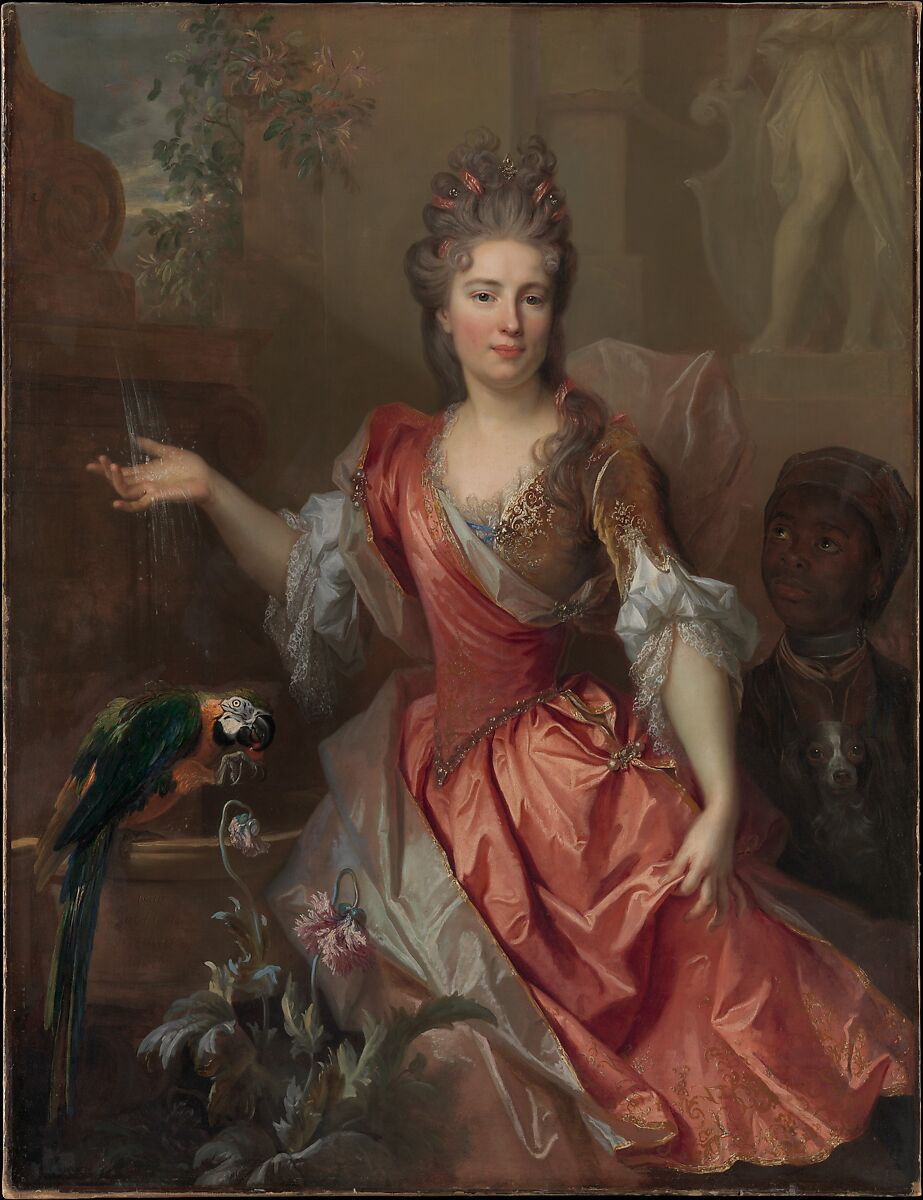
Despite her descriptions of an enslaved prince and the inhuman brutality he faced at the hands of European oppressors, Behn does far more to further embed the concept of inherent difference than she does to unravel it. Much like Wilberforce, equality never appears to enter the narrative in any true sense as a critique of colonial white supremacy. This is arguably rather evident by the end of the novel, where Oroonoko’s uprising against enslavement is ultimately foiled and he is subjected to brutal physical punishment which renders his body a symbol of affirmed colonial dominance. Though no longer commodified according to his beauty, Oroonoko’s physicality now has value in the provision of spectacle. This is as dehumanising as reduction to mere ornament, though now weaponised as part of a systemic effort to subdue and further exploit. Later, Oroonoko kills his wife Imoinda and in a moment of excessive brutality removes her face. Though Behn constructs a narrative which suggests this act of violence occurred to save Imoinda from further suffering, the nature of the violence depicted does little to assuage the idea that Oroonoko is now further othered by his monstrosity. Indeed, Behn describes him as a ‘monster of the wood’ while he falls into a vivid expression of grief and rage.
Oroonoko’s death in the final passages of the book solidifies his status as object, depicting visceral mutilation beginning with the removal of his genitals. Behn extricates herself from her prior fetishisation of the Black body in favour of its dismantling, symbolic of Oroonoko’s supposed savagery diminishing the value of his physical beauty. Thus, he is rendered of little value. In addition, Behn states Oroonoko ‘still smoked on, as if nothing had touched him’ while parts of his body were removed. This is an image which evokes yet another form of othering, whereby European scholars such as Hans Sloane later proposed Black African people do not experience pain or sickness in the same way that a white European might, favouring treatments akin to forms of torture.
Through her comparisons of the Black body to exotic items of furniture and decorative embellishments, she reinforces the notion that the value of Blackness lies in its commodification. In doing so, Behn appears to favour the abolition of slavery not because she sees Oroonoko as her equal, but because his physicality renders him more valuable as an ornament to be fetishised and admired by a white, European audience. It is perhaps unfair to claim there are no explicitly abolitionist elements in the novel, as it is clear Behn sees herself as a storyteller whose purpose it is to bring to a wider audience an understanding that Black African people have value beyond their labour in economic terms. However, she does little to suggest this is due to an inherent equality which transcends the social reality of race, instead seeing value in different kinds of commodification. By fetishising Blackness, Behn’s work corresponds to historic patterns of positioning the subaltern in the role of ornament or symbol. By differentiating Oroonoko from his fellow enslaved people on the basis of aesthetic appeal, he becomes part of an economy based on exoticism and colonial displays of power. Furthermore, Oroonoko’s physicality is later used against him in a way that perpetuates the myth of genetic difference and white exceptionalism. Though influential and by no means pro-slavery, it is easy to see how the motifs embedded throughout Oroonoko; or, the Royal Slave may have worked to secure the establishment of racial hierarchy rather than unravel it.
What followed Behn’s early writings on the subject of African subjugation echoed her paternalistic approach rooted in the continuation of racial hierarchy. In what would later become an extremely influential white abolitionist sphere, William Wilberforce claims a particularly prominent position as a figure most often associated with his presentation of the abolition bill to Parliament over several years until it was passed in 1807. This dedication to the end of trade in enslaved peoples by Britain does of course alter the trajectory of history significantly, adding weight to a growing cause for abolition in its entirety. Wilberforce quite rightly affirms his place in the annals of history.
However, as we will come to continually discover, a dedication to the abolition of enslavement does not necessarily align itself with meaningful belief in equality, nor does it mean the motivation behind abolitionism is connected entirely to the notions of shared humanity or antiracism that symbols such as the Wedgewood anti-slavery medallion are thought to represent. Indeed, in his writings on the subject in 1807, Wilberforce himself declared Black African people as being inherently incapable of reaching truly equal status, stating the ‘poor degraded’ enslaved people ‘are as yet incapable of enjoying freedom.’ He contended that to grant this ‘would be to insure not only their masters’ ruin, but their own.’ Thus, we can see Wilberforce’s feelings on systematic exploitation of Black people are far more complex than the white saviour narrative he has so often been attributed, demonstrating paternalistic, inherently white supremacist perspectives underpinned by economic concerns. Despite his famously fervent opposition to slavery and subsequent parliamentary success, Wilberforce does little to challenge the cultural hegemony of the time which positioned the white, wealthy European at the top of an invented global hierarchy. This dichotomy between condemnation of slavery and an ideological alignment to the violently racist attitudes which had upheld it mark clear ethical inconsistencies within the work of certain well-known abolitionist figures. It is through our interrogation of these hypocrisies we might come to better understand the role of historical narrative in embedding forms of oppression.
Further Reading:
Aphra Behn, Oroonoko (Penguin, 2016).
Michael Taylor, The Interest (Bodley Head, 2020).
David Olusoga, Black and British (Pan Macmillan, 2017).
Irvin Weathersby, In Open Contempt: Confronting White Supremacy in Art and Public Space (Viking, 2025).
Digital Resources:
National Trust Collections
Saint Louis Art Museum
Dr Isabel Gilbert is a lecturer and historian whose research focuses on colonial legacies, decolonial practice, interpretation and social justice. She studied for her PhD at the University of Sheffield where she wrote her thesis titled 'How have colonial legacies and museum interpretation perpetuated systemic racism and to what extent can anti-colonial approaches to this history enable change? '. Isabel is passionate about anti-colonial work and diverse narratives in museums, historic places and scholarship. She is a lecturer at the University of Worcester.


