


Stripped Bare: The Caricature Assassination of Mr Punch in Private Eye

James Jones │ Lancaster University
The Imperial Storybook: ‘Mr Punch’ as Pulpit
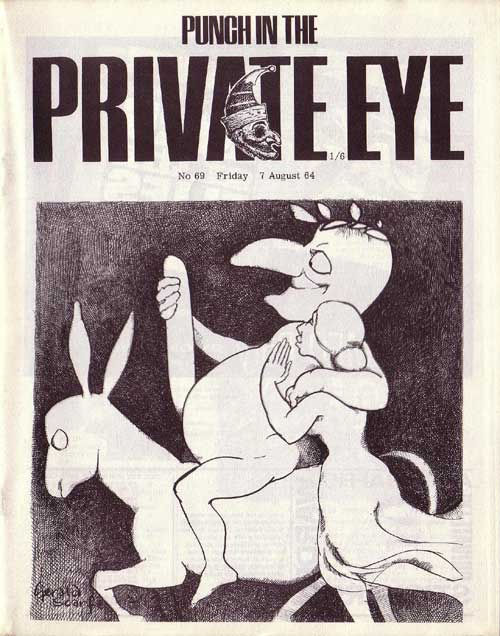
On August 7, 1964, Private Eye, an emerging satirical cartoon magazine published this cover. Drawn by Gerald Scarfe, ex-Punch cartoonist, it unintentionally marked the end of an era in caricature. Since the mid-nineteenth century, the cartoon had been a pulpit of the political class, upon which they would lampoon those of all steps on the social ladder, particularly the most vulnerable and unable to defend themselves from drawn slander. Winston Churchill once said that the Punch cartoon was the ‘food’ of the political class, whom he described as ‘grown children’, indeed he even argued that cartoons had affected voting intentions. Punch was thus an aristocratic tool, a mallet used to beat all those who refused to follow the imperial line and a straitjacket, to keep everyone in their ‘place’ in the imperial storybook.
Like all story books, Punch had an array of characters. First, its selection of stereotypes from which its cartoonists plucked to make the next joke, and second; the roster of characters who drew the cartoons and wrote the jokes. Both sets of characters are vital for the fundamental, academic understanding of the cartoon and its historical agency. Its foremost character, of course, was ‘Mr Punch’. Mascot since 1841, he had made the magazine a ‘British institution’, embedded figuratively in the national conscience and literally in England’s many libraries. The cover of Private Eye, illustrated by one the most influential cartoonists of the twentieth century, Gerald Scarfe, placed Mr Punch in the pillory and hurled an unforeseen number of tomatoes right at his large nose. The caricature of Mr Punch, penis in hand, made a laughing stock out of the middle-class respectability that Punch had built up over its 113 year tenure. Indeed, while I refer to it as a pillory, it may be more apt to refer to this as a gallows upon which Mr Punch was hung. He spent the next forty years hanging there, chewed up by crows and worms, circulation falling until eventually the entire magazine, once the monolith of the genre, fell in the face of waning cultural relevance and stronger, cruder competitors.
Punch was, for a very long time, the dominant cartoon publication in Britain. Though it is typically looked at academically during its Victorian heyday, its circulation peaked in 1948 at 175,000 issues, and circulation stayed above 150,000 well into the late 1950s, with numbers steadily falling to 125,000 in 1969 and 33,000 when the magazine shut down for the first time in 1992. Scarfe’s cover suggests when Punch’s fate was sealed. The skull in the title further evoked the publication’s death.
While Private Eye was certainly a more crude publication, relying on basic printing technologies such as the collage of printed photographs and linotype text and described by Humphrey Carpenter as a ‘scruffy yellow pamphlet’, it was far from a grassroots paper. The magazine’s founders, Richard Ingrams, Christopher Booker, and Willie Rushton were graduates of Shrewsbury School and Oxford University. They were part of a post-war generation that, as Stuart Ward illustrates, ‘had been raised on pre-war notions of duty and service to nation and empire, only to reach maturity at a time when these ideas could no longer be sustained by external political realities’. To these students, Punch was no longer a mirror of imperial truth but a curtain that hid the reality of diminishing imperial fortunes. Punch had established itself in the 1840s as a defiant upstart which existed as part of, yet somehow separate from, elite media culture. By the 1950s, this image had fundamentally changed in favour of mainstream political attitudes. As Carpenter argues, Punch had reduced itself to ‘Christmas-cracker level humour’, describing Mr Punch as ‘the uncritical, harmless jester of the Victorian Establishment’.
The Satire Boom: From Bouverie Street to Soho
Private Eye did not act in a vacuum. It functioned as the print-arm of a broader cultural shift, the Satire Boom (1960-1963). Satirists like Alan Bennett and Peter Cook, through Beyond the Fringe, openly mocked institutions Punch represented, including the church and the army. These men had proven there was a market for humour that crossed the lines of middle-class respectability. Peter Cook used his earnings to open an entire nightclub in Soho, ironically called ‘The Establishment’, dedicated to satire. This club acted as the unofficial headquarters for Private Eye’s founders; a safe space where anything went.
For over a century, the ideological soul of Punch was maintained at their Wednesday dinners, held at its Bouverie Street offices. This was where the inner circle of Punch’s elite contributors carved their initials in the famous Punch table and decided the week’s ’Big Cut’ (full page cartoon). Ultimately this is where the ideological line of the week's issue would be drawn, by those with most seniority. In stark contrast, the founders of Private Eye rejected the fine mahogany table for the sticky carpet of a local pub, the ‘Coach and Horses’ in Soho. The environment in which Private Eye was produced was thus one that was both more down to earth, but also completely unfiltered. Christopher Booker describes Soho as a world of ‘strip tease and gambling saloons’ where satirists became the ‘first expression in society of a darker longing for sensation, chaos, and collapse’. While Punch contributors likely viewed it as the underbelly of London, it was a fertile ground where the alternative and progressive were flourishing. This exposes a greater cultural dichotomy that occurred as a result of the fragmenting imperial psyche. As Stuart Ward states, Imperial downfall had a ‘variety of responses’, from ‘anger and resentment’ to ‘a mournful nostalgia for a more resolute and certain age’. While Private Eye constituted an aggressive cultural outburst that targeted everyone and everything, Punch remained mournfully nostalgic for a time long gone.
This cultural sea of change was most explicitly represented by the broadcasting of That Was The Week That Was (1961-1962). The programme, broadcast by the BBC, humiliated every symbol of authority in Britain. From mocking the royal family’s wavering relevance to the 1963 ‘Profumo Affair’ sex scandal, to the ranking of religions as lifestyle products. For a programme of its time, it took no prisoners. The BBC themselves claim the programme ‘took aim at the establishment in a way that has never been seen on the BBC before’. The show was pulled because of the 1964 election year, revealing how Churchill’s fears of anti-establishment media influencing voting intentions were not entirely unfounded. This cultural environment, in which the Empire was being conceded and the government muzzled by the media was the time in which Gerald Scarfe, amongst other disgruntled upstarts, sat down and drew their scathing artwork. The public had been conditioned by the proliferation of anti-establishment media to both expect and enjoy the ceaseless humiliation of their leaders. As Ward points out, there was the ‘emergence of a cynical contempt towards politicians’. Punch’s mallet had been turned against him, instead of beating those at the bottom, the media was exploited to whack down those at the top.

The original image, drawn by Richard Doyle, pictured above, was the cover of Punch from 1849 all the way to 1954 when each issue was given a unique cover. The design was a double entendre, providing on one hand an unassuming image of Mr Punch riding a horse and holding a flagpole for the date of the issue. On the other hand, the observer could look very closely and see a gap between the flagpole and the flag itself. Whether this was intentional or not is unclear; but such an explicitly sexual joke would be out of character for any publication of that period, never mind one that was read by royalty. If Doyle’s cover was a Victorian Rorschach test, Scarfe’s 1964 expansion violently deconsecrated those sensibilities for a new era of caricature. Much of my research focuses on how cartoon publications handled issues of national identity and this new direction could not be seen any clearer than in how each magazine covered Enoch Powell and his ‘Rivers of Blood’ speech in 1968.

Punch stuck to basic, respectable metaphors of Enoch Powell supporters as venomous snakes, Private Eye, meanwhile, chose the most vulgar and crude imagery possible: a monkey with his hands where the sun does not shine. Simian features, which had been used in previous years in Punch to misrepresent Black people, were instead used to depict Britain’s most outspoken representative of white issues. This cartoon is a prime example of the cultural inversion Private Eye represented, with comparisons of Powell to Hitler, it was a no-holds-barred competitor that drew no line when it came to making a joke.
Mr Punch: Greek Deity

This lack of comedic restraint is precisely what positioned Private Eye as the executioner of the ‘respectable’ cartoon. For over a century, Doyle’s cover was a domesticated Bacchus. The image at the bottom of the frieze, is evocative of the Triumph of Bacchus; the Greek god of wine and ritual madness. The Punch cover is hardly the typical violent and sexual procession the Greeks imagined. Drunken revellers were replaced with children and sprites. It was a blending of ancient folklore and the class of a renaissance painting to demonstrate an awareness of high culture and western history. Mr Punch was a Bacchus-esque figure, who maintained the cheerfulness and freedom of the Greek deity without the depravity. This balancing act performed the role of justifying Punch as the pressure valve for the lighter sentiments of the higher orders.
The 1960s were a time in which societal conventions, especially around sex and the censorship of explicit material, were changing. The 1960 trial of the infamous novel Lady Chatterley’s Lover served as a cultural permission slip for sexually themed literature. When the jury ignored the prosecutor’s plea, asking if they would let their servants or wives read it, they signalled the ongoing cultural shift. The public no longer required domesticated Bacchus or media that deemed certain ideas too depraved for public consumption. The chalk line that Punch tiptoed along so carefully was rubbed away in what seemed like no time at all.

Private Eye permanently transformed Mr Punch from a Bacchus to a Priapus; the rustic god of fertility, known for his oversized erection. Scarecrows were made in his grotesque likeness to ward off evil through his disgusting nature. By expanding the image and detailing Mr Punch’s nudity, Scarfe turned Mr Punch into a scarecrow that warded off the middle-class readership he had originally attracted. The mask of Mr Punch as a character with which the governing classes could identify, a provider of moral conduct and comedic values, was literally stripped bare. Scarfe exposed the Priapic reality behind Punch, its archaic discourse and under the surface, the danger it posed to a multicultural society.
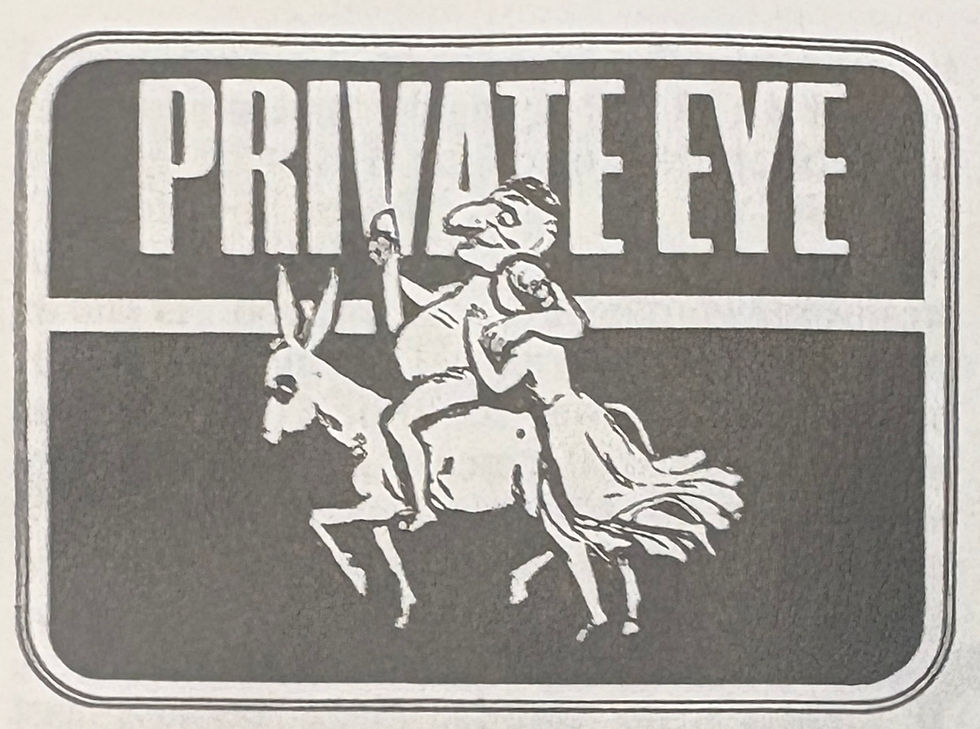
Despite the brazen skull in the middle of the Private Eye title, Mr Punch was not allowed a quiet burial. His phallic depiction was made the masthead for the magazine’s news page which is where it stays even to the present day. Mr Punch has been left in an endless state of humiliation, the image constitutes a headstone for Punch Magazine. Private Eye’s Mr Punch didn’t have to adjust to changing imperial realities, instead he made a mockery of polite society as a whole. By the time Punch finally vanished in 1992, The Priapic Scarecrow had won, proving that the reading public had chosen the naked truth. Scarfe’s exposure of this Priapic reality behind Punch serves as a precursor to contemporary debates around the display of injurious material. There remains an inherent tension between the historical necessity of auditing the grotesque and the modern curatorial impulse to manage potentially offensive narratives. An over-reliance on sanitation risks an archival erasure that obscures the evolution of the imperial psyche. By retreating from the raw evidence of caricature, the discipline risks losing the very tools required to understand how British identity was, and is, constructed.
Further Reading:
Richard D. Altick, Punch: The Lively Youth of a British Institution, 1841-1851 (Columbus: Ohio State University Press, 1997).
Christopher Booker, The Neophiliacs: A Study of The Revolution in English Life in the Fifties and Sixties (London: Gambit, 1970).
Humphrey Carpenter, That Was Satire That Was: The Satire Boom of the 1960s (London: Victor Gollancz, 2000).
Gerald Scarfe, Drawing Blood: Forty-Five Years of Scarfe (London: Little, Brown, 2005).
Stuart Ward, British Culture and the End of Empire (Manchester: Manchester University Press, 2001).
James Jones is an MA History student at Lancaster University and a full-time supply teacher. A first-generation student, he was awarded the Queen Elizabeth Scholarship for best Part 1 performance and received the Andrew Pearson Prize in 2024 for his undergraduate dissertation, ‘Knocking Them Down: Punch’s Problematic Portrayal of Black People in The Interwar Years’. His current MA research, ‘Punch Drunk: Imperial Anxiety and the Intoxication of Caricature, 1961-1976’ explores the intersection of drawn satire and British identity during the dissolution of the British Empire. James is currently developing these concepts into a comprehensive PhD project spanning 1918-1979.


