


‘Latinity’ in Gregorio Marañón’s Imaginary

Updated: Sep 10
Ezequiel Varela-Vázquez │ University of Leeds

When you associate ‘Latin’ with a geographical area, what comes to mind? I imagine countries that speak mostly Spanish, and are situated in Latin America. In Spain, ‘Latin’ is now more commonly associated with Latin America, but ‘Latin’ also refers to countries in which most of the population speaks a Romance language, such as Spain, France, Italy, or Romania, which were all once thought of as Latin.
This begs a larger question: What is ‘Latinity’? One of Spain’s most revered physicians of the twentieth century, Gregorio Marañón y Posadillo, characterised Latinity as a cultural inheritance of the Roman Empire which was initially passed on to formerly Roman territories in Europe. It was then exported to Latin America via colonial exploitation before the creation of independent republics. Latinity was viewed by Marañón as a shared culture and values system which was unique among these countries. Some of these shared values were religion (such as Catholicism) or the non-endorsement of ‘negative eugenic measures’, such as sterilisation or the enforcement of pre-marriage certificates. Marañón always considered nations such as Spain the ‘original Latin ones’, while he relegated Latin America to a secondary position. This culture thus, was not ‘shared’ as much as it was imposed in the Americas through colonial power relations. Marañón’s understanding of Latinity evolved in the first half of the twentieth century, influenced by political events in Europe as well as the development of eugenics as a field of study.
Gregorio Marañón y Posadillo (1887-1960) was the son of Carmen Posadillo Vernacci (1859-1890), who died shortly after his birth, and the lawyer Manuel Marañón y Gómez-Acebo (1853-1920). Gregorio Marañón studied at the Central University of Madrid, excelling in medicine and winning the Martínez Molina prize for academic performance before studying in Germany under the Nobel Prize-winning physician Paul Ehrlich (1854-1915). After this, he returned to Spain, where he worked as a doctor in the Central Hospital of Madrid. He was a tireless writer: he authored at least 125 books, over 1,800 articles (including 1,000 research papers), thirty-two monographs, and 146 conference papers, some of which were translated into other languages. These writings covered many topics, including gender roles, eugenics, and history. Crucially, Marañón was also deeply interested in concepts and understandings of race.
During the First Bourbon Restoration (1876-1931), Marañón held political positions such as Public Health Advisor (1919) and Minister of Public Instruction (1920). However, during Miguel Primo de Rivera’s dictatorship (1923-1929), Marañón did not enjoy that same popularity. Certain academic events such as the First Spanish Eugenics Course (1928), where Marañón was one of the main speakers, were forcibly cancelled by the dictator under the accusation of ‘promoting pornography’.
Throughout the first quarter of the twentieth century, Spain experienced two intellectual movements which were closely connected to each other: ‘degeneration’ and ‘regeneration’. The ‘degeneration’ movement believed that the Spanish ‘race’ was degenerating and that Spaniards were lagging behind their European counterparts, especially England and Germany. ‘Regeneration’, meanwhile, was popular amongst Spanish politicians, reformers, and the professional classes who sought to stop or reverse the degeneration of Spain through eugenicist policies. These movements, ‘degeneration’ and ‘regeneration’, are part of the same continuum rather than two separate currents: both identify the Spanish race as ‘degenerate’, but only the regenerationists searched for ‘solutions’ to ‘fix’ the perceived ‘degeneration’.
Marañón too endorsed this view of racial degeneration. As one of the first endocrinologists in Spain, in a speech following his entrance to the Spanish Royal National Academy of Medicine in 1922, he claimed that the ‘race of Spain’ was intellectually inferior to the ‘Anglo-Saxons’ on matters such as endocrinology. Thus, he distinguished between the ‘advanced’ ‘Anglo-Saxon’ race and the ‘backward’ Spanish race. This discourse was not new in Spain. After the liberation of the last American colonies of the Spanish Empire in Cuba, Puerto Rico, and the Philippines, Lord Salisbury stated in his speech on ‘dying nations’ that Spain was a degenerating nation. Therefore, Marañón’s rhetoric connected with the broader degenerationist movement, as he was trying to analyse the reason for the alleged decay of the Spanish race.
Whilst Marañón did not use the term ‘Latin race’ in this period and his precise understanding of what constituted ‘Latin’ in the 1920s remains ambiguous, his theories changed considerably during the following decade. Marius Turda and Aaron Gillette define Latin eugenics as a social, cultural, and political programme developed in Latin American nations and in ‘Latin European’ states such as Spain, Portugal, France, Romance-speaking Switzerland, Romania, Croatia, Belgium, and Italy. This movement was contrary to the mainstream movement of eugenics, mainly championed in England, Germany, and the United States, in which eugenicists believed that negative racial traits were inherited from generation to generation, giving little to no importance to environmental conditions. By contrast, eugenicists from Latin countries typically followed a less genetic approach to eugenics.
Englishman Francis Galton (1822-1911) conceived the concept of eugenics in 1883 as ‘the science of the improvement of the stock’. With ‘stock’, Galton meant to promote the natality of the English upper classes. This movement gained popularity worldwide, and eventually three world congresses on eugenics took place in London (1912) and New York (1921 and 1932).The main topics discussed in these congresses were the importance of inheritance, potential measures to reduce ‘undesirable offspring’, and how to coordinate eugenics societies which appeared across the world.
In 1932, Corrado Gini (1884-1965), the representative of the Italian delegation to the Third Eugenics International Congress, stated that race was not what the Anglo-Saxon eugenicists endorsed. For Gini and most Latin eugenicists, the environment in which races thrived was more important than genetics. Gini started his own league in 1935, entitled the ‘International Federation of Latin Eugenics’. This league included societies of eugenicists from multiple countries in Latin America, and what was known as ‘Latin Europe’. Spain did not have a Society of Eugenics, but the region of Catalonia within Spain had a Societat Catalana d'Eugenèsia (Catalan Eugenics Society), which was a part of Gini’s Federation for a short period until the start of the Spanish Civil War in 1936. The start of the Second World War in 1939 eventually brought an end to this federation, as ‘Latin’ nations such as France and Italy fought on opposing sides during this war, which undermined notions of a shared ‘Latin’ European racial identity.
These international changes affected authors such as Marañón. Just as the International Federation of Latin Eugenics started to hold its first congresses, the Spanish Civil War (1936-1939) erupted. This conflict started after factions within the Spanish army, led by General Francisco Franco and backed by Benito Mussolini (1883-1945) and Adolf Hitler (1889-1945), challenged the legitimately elected left-leaning government of the Second Spanish Republic (1931-1939). The war forced Marañón to flee Spain, first to France, and then to Uruguay, Argentina, Chile, Brazil, Peru, and Bolivia to transmit this idea of ‘Latinity’ as a ‘civilising force’. During his years in exile (1936-1942), he contacted other eugenicists and visited other countries, such as France, where he gave a speech on ‘Latinity.’ Marañón spoke about his notion of Latinity between August and September 1939, stating:
[Latinity] was the primary attempt to look for the middle point of everything: to reunite tradition and progress, hierarchy and freedom, the utility of beauty and the rigorous technique of creation. Due to this fact, the empire of Latinity, the most universal of all the notions of collective life, will start from the shores of the Danube, where the eagles of Rome were buried, and finish at the Republics of the American continent.
Marañón’s texts continuously proposed uniting ‘tradition and modernity’ without specifying what these concepts meant, but he was clearly interested in promoting an idea of order in Spain without losing the scientific advances of the previous decades.
The Spanish Civil War was fought between the supporters of the democratically elected left-leaning government of the Second Spanish Republic, which included socialists, communists, and pro-democratic politicians of diverse backgrounds, and the supporters of Franco, who appeared more united and claimed to embody the ‘real spirit’ of Spain. Marañón initially labelled the Second Spanish Republic as the necessary vessel for progress, which Spain needed in the early 1930s to ‘catch up’ with ‘Anglo-Saxon’ nations. However, the Second Spanish Republic did not uphold these expectations for Marañón. Therefore, he endorsed Franco during the Spanish Civil War, in a pamphlet called Liberalism and Communism; the background of the Spanish Civil War (1937). Whilst Marañón defined Franco’s regime as anti-democratic, he also saw it as anti-communist and ‘European’, while he defined the Second Spanish Republic as anti-democratic, communist, and ‘oriental’. Thus, he endorsed Franco’s side as ‘less evil’ for the development of the Spanish ‘race’. The Spanish Civil War ended with the defeat of the Second Republic in April 1939, which marked the start of an authoritarian regime led by Francisco Franco until 1975.
Marañón explained in Paris that ‘barbarians’ were fighting on the ‘Revolutionary Front’ against the ‘Latin Front’. Whilst he did not specify who the ‘barbarians’ or members of the ‘Revolutionary Front’ were, Marañón appeared to be calling some of the supporters of the Spanish Second Republic barbarians, likely the communists and the anarchists. Additionally, he referenced Spain as an example of a ‘Latin’ country successfully defending its ‘Hispanism’ (cultural inheritance from the Spanish Empire) from the enemies of the true Spaniards, presumably most of the supporters of the Second Spanish Republic.
Another key idea in Marañón’s talks was his ideal ‘Latin Arch’, which would be divided into two blocks: the ‘European Block’ (France, Italy, Portugal, and Spain) and an unspecified ‘South American Block’. Marañón did not consider Latin America nations as racially equal to Spain, France, Portugal and Italy. Following Marañón’s map, the four European countries are the originators of Latinity, as he even refers to Spain as the ‘mother’ of the Latin American countries in his conference papers. This vision is rooted in a colonialist view of Latin America: in Marañon’s view, the European countries should be and were the ones ‘leading’ the Latin Eugenics Movement as the ‘Latin race’ started there.
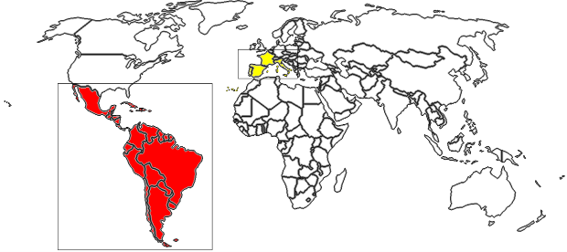
Throughout his period in exile, Marañón’s notion of race evolved from a distinction between Spain and other ‘more advanced’ European nations in the 1920s to a global vision of ‘Latinity’ in the late 1930s, influenced by the Latin Eugenics Movement championed by Gini. The latter idea blended the concept of ‘progress,’ which the discipline of eugenics represented for the author in the 1920s, with a belief in ‘hierarchy’ or ‘respect for the social order.’ Ultimately, Marañón’s exile during the Spanish Civil War led to a reappraisal of his previous ideas as he believed the Second Spanish Republic failed to respect the social order. Therefore, Marañón considered Franco’s side as the one suited to embody the real ‘Latin race’ of the Spaniards.
Furthermore, Marañón did not view all ‘Latin’ countries equally. This division was made clear in his construction of the Latin Arch, which exemplified his belief that European nations, including Spain, were the most important, while Latin America occupied a secondary position. This mindset championed by eugenicists such as Marañón, rooted in imperialist thought, still remains understudied in Spain. The ‘Latin race’ in which Marañón situated Spain was not the same as the ‘Latin race’ which he situated in Latin American countries. As Chloe Campbell shows in Eugenics in Colonial Kenya (2007), ‘[…] to understand better the British eugenics movement, we need to recognise how central eugenics was to colonial racial theories, and that in Britain itself, eugenics was deeply connected to the ideology of empire’. Building on Campbell’s work in the context of British colonialism, the linkage between eugenics and imperialist thought in the Spanish eugenics movement could shed light on how deeply eugenics was intertwined with the ideology of the empire in Spain.
Further Reading:
Joshua Goode, Impurity of Blood: Defining Race in Spain, 1870-1930 (Louisiana State University Press, 2009).
Mark B. Adams et al., The Wellborn Science: Eugenics in Germany, France, Brazil, and Russia, edited by Mark B. Adams (Oxford University Press, 1990).
Stefan Kühl, For the Betterment of the Race: The Rise and Fall of the International Movement for Eugenics and Racial Hygiene (Palgrave Macmillan, 2013).
Nancy Leys Stepan, "The Hour of Eugenics": Race, Gender and Nation in Latin America (Cornell University Press, 1996).
Marius Turda and Aaron Gillette, Latin Eugenics in Comparative Perspective (Bloomsbury Publishing, 2014).
Ezequiel Varela-Vázquez is a PhD-funded student who started his PhD at the University of Leeds’ School of History in 2025. Ezequiel completed his bachelor’s degree in history in Santiago in 2022, when he was awarded the Extraordinary End of Studies Prize. Next, he studied for an MA in History in 2023 at Oxford Brookes University, where he graduated with a distinction. He was awarded the Detlef Mühlberger Prize for the best MA dissertation. Then, he went on to complete a Teaching Master's in 2024 at the Complutense University of Madrid. At the same time, he also received a JAE-Intro scholarship to work with the Spanish National Research Council. Finally, he was awarded a White Rose scholarship to research how eugenic ideas circulated in Spain. This work was supported by the Arts & Humanities Research Council (grant number AH/R012733/1) through the White Rose College of the Arts & Humanities.


