


‘Fighting our Fathers’ Cause’: The British Press and the Waterloo Centenary

George Tanton │Canterbury Christ Church University
Now once again flares forth the Overman –
The Kaiser, with his World-o’erwhelming plan;
Yet even already cometh dreadful fate –
And Britain struck the blow – well may he hate;
For Ypres is, like Hougomont, the rock,
Where first his mighty squadrons felt the shock;
His shattered armies fail;
His lurid bale-fires quail –
But lo! For aye on Ypres’ ancient town
More bright than Waterloo there shines a glory-crown
- ‘Ypres and Waterloo’ by an Edinburgh Borderer, published in The Berwick Journal on 1 July 1915
With her resolve hanging by a thread, Britain’s conflict with Germany in 1915 had evolved from a mobile war to a stalemate characterised by attritional trench fighting, the use of poison gas, doomed offensives, and high casualty rates. The brutality of it all, coupled with the allegations of German atrocities in France and Belgium, horrified the British people. Seeking to improve morale on the home front, the British press capitalised upon the centenary year of the Battle of Waterloo - commemorated on 18 June - and reframed the Great War in the public imagination, emphasising and re-examining Britain’s role as defender of Europe against what was considered the resurgence of Napoleonic tyranny. The national struggle against Napoleon was revised to suit the moral quandaries of the war with Germany; both conflicts were presented as parallels about preventing hostile states from gaining hegemony in Europe, as well as defending the British way of life from foreign tyranny. Within this narrative, Napoleon was reimagined as a continental bogeyman, whose spectre was very much alive in Kaiser Wilhelm II’s ambitions to subjugate Europe.
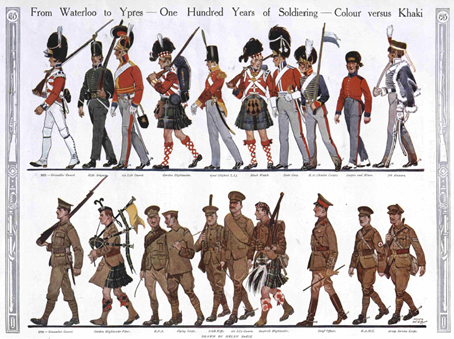
In the immediate years following the defeat of Napoleon Bonaparte, Waterloo was fondly remembered in Britain as a triumph of national character - a victory over continental despotism and a moment of liberation for Europe. However, by the 1880s, ‘Waterloo Day’ was no longer considered with the same reverence. The last surviving British veteran of Waterloo, Samuel Gibson of the 27th (Inniskilling) Regiment of Foot, had died in 1891, and with him, so did the last living link. In some circles, celebrating the battle evoked controversy and even embarrassment, considering that Bonaparte’s great-nephew, Louis-Napoléon the exiled Prince Imperial of France, was killed during the Zulu War (1879) in the service of the British. By 1904 and the signing of the Entente Cordiale, celebrating the battle was feared to insult the French! Previously, one London correspondent in 1888 sadly remarked that:
It is true that as 1815 has receded further and further from our view the last of “the decisive battles of the world” has lost its old keen claim upon the attention of the remembrance of the nation. Time was when “Waterloo Day” was faithfully celebrated upon each recurring eighteenth of June, and when in the enthusiasm of recent recollection it was imagined that the anniversary would never be allowed to pass without a public testimony of gratitude for the victory won. But time which soften griefs tone down memories, and to-day Waterloo is seldom talked of, and the anniversary has ceased to be publicly remembered.
In response, another columnist chose not to lament the passing of time but to take heart from the optimism and achievements of future generations. ‘We know more and we do more than our fathers did in the year of grace, 1815, and in the moment of supreme need we could, no doubt, rise to the occasion quite as magnificently,’ he wrote, completely unaware of the significance his words would later have.

At the beginning of 1915, German air-raids on East Anglia had resulted in the first British civilian casualties of the First World War. This outrage was followed by Germany’s use of chlorine gas on Allied positions at Ypres, and the sinking of the civilian liner RMS Lusitania by a German U-boat. British sensibilities were further shaken by the publishing of the Bryce Commission’s Report on Alleged German Atrocities in Belgium and France. With the war seemingly not swinging in Britain’s favour, the Waterloo centenary arrived at a pivotal moment. However, upon the passing of the centenary, there was no large-scale civic commemoration; Trafalgar Square was not adorned with Union Jack bunting, there was no symbolic chiming of church bells across the land and no triumphant march from Horse Guards to Wellington Arch. In this climate of wartime austerity and sombre public mood, only limited, humble acts of commemoration were made. Flowers were placed on the tomb of Sir Arthur Wellesley at St Paul’s Cathedral, while The Times reported upon a stoical service at Wellington College which had the ‘added solemnity suited to the 100th anniversary and the tremendous circumstances of this year’. The Waterloo centenary was, however, jumped on by the press, who presented it as nostalgic reminder to the reading public of a glorious national past, a time when British force-of-arms had wrestled victory in Europe from one of the greatest warlords of the modern age. Reflecting upon this, the editor for the Huddersfield Daily Examiner wrote:
There is a similarity between 1815 and 1915 which goes deeper than accidental or superficial differences. Once more, as a hundred years ago, our country and the best of Europe are ranged against a cruel and autocratic despotism which threatens the liberties of the world. Once more we are fighting a tyrant whose success means the ruin of all fair hopes of liberty, and a crushing defeat to civilisation. And it is this feature, above all, which makes us look back to Waterloo Day with a strong and inspiring consciousness that as we fought with and conquered the Corsican despot, so we will fight with and conquer Teutonic militarism and the hateful rule of Kaiserdom.
In a similar message, the editor of The Lyttelton Times explained that Waterloo was more than just the defeat of the French. It was the ‘smashing of a system’ resulting in the ‘final deliverance of Europe from a military despotism for a hundred years.’ Since then, Europe had accordingly enjoyed a universal peace until the Kaiser had chosen to inflict his own bloody-minded ambition upon the continent. Britain was now facing the prospect of fighting a ‘far greater Waterloo’ against the ‘menace to the peace of the world.’

Contemplating the significance of the centenary, a columnist from the Manchester Courier could not help but see the irony in commemorating the downfall of a dictator a century before, when Europe was in the present grip of another:
In happier times the Centenary of Waterloo would have been a memorable event. As it is we think less of the battle which overthrew a despot than of the attempted despotism of Germany, which is causing battles on a scale such as Napoleon and Wellington never contemplated. To-day’s commemoration finds the classic field of Waterloo in the occupation of German enemies. A few miles away Englishmen, Frenchmen, and Belgians are fighting a new battle for liberty.
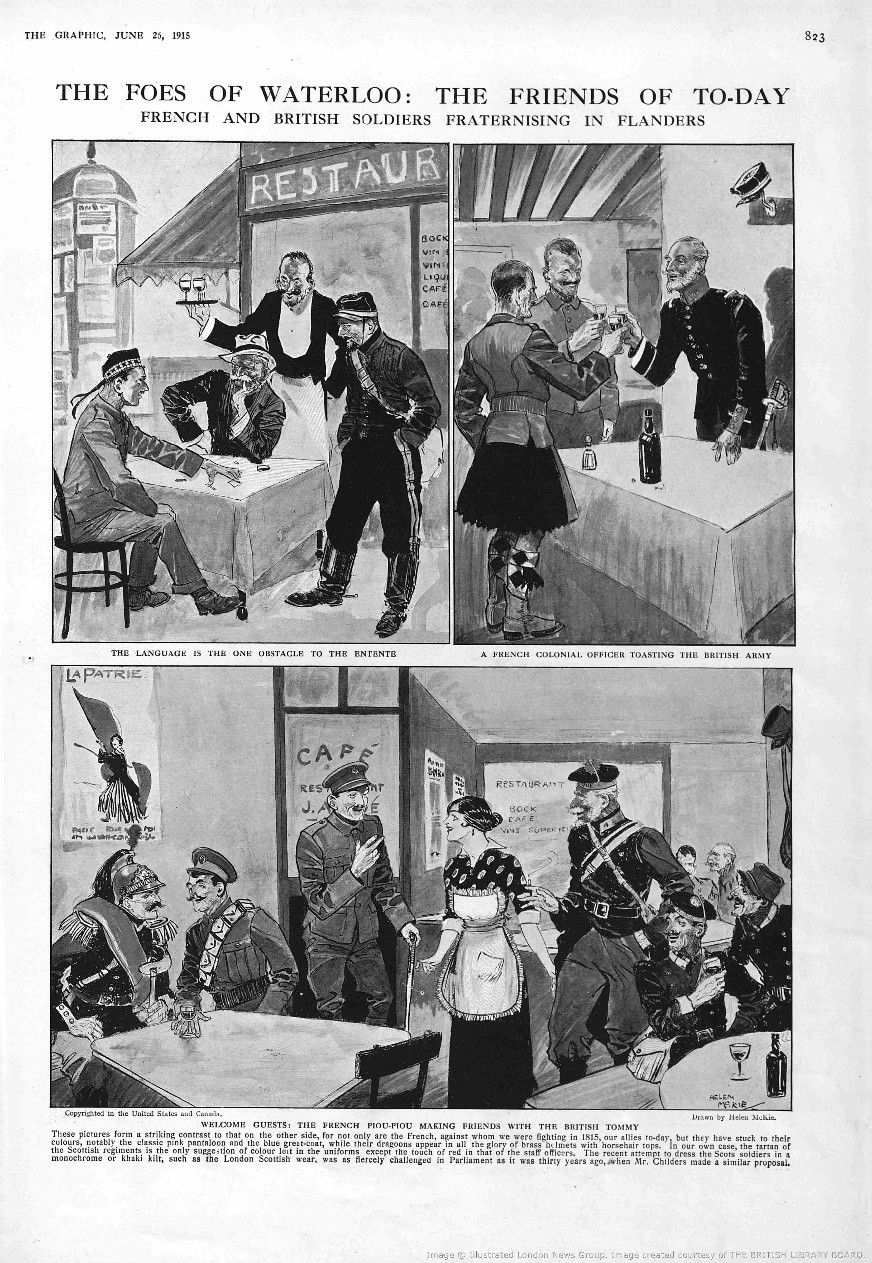
This concept of a European alliance against Germany gained momentum in the British press. Editorial commentaries compared the Allied Powers of 1915 with the Seventh Coalition of 1815, albeit lamenting the absence of Prussia in its new form as Imperial Germany but welcoming a reformed France as an ally. During this time, the French high-command had criticised the British for ‘inaction’ in light of the petering Anglo-French offensives in the Artois sector, and the alliance was stretched. Regardless, British columnists were keen to play down the vitriol characteristic of Anglo-French relations in the previous century, instead presenting the Prussians as having been the true aggressors. The Germans, therefore, had inherited all the malice and brutality of what contemporaries coined as ‘Prussian militarism’. A writer for the North Wilts Guardian observed:
The Duke of Wellington has left it on record that of all the plundering scoundrels he ever came across the Prussians were the worst. Had Blucher captured Napoleon, it is most likely he would have shot him.
Similarly, a correspondent for the Manchester Evening News suggested:
Austrians and Germans who, in the hour of triumph, were anxious to bleed France white, to impose upon her restrictions which would have kept her from the ranks of the Great Powers for many generations if not for ever. Great Britain, with the co-operation of Russia, crushed that project. We had no quarrel with the French people. We did not desire to ruin the French nation… To-day she is our glorious ally, and it is significant that she is opposing with us with all her might and main, another fiendish attempt to crush Europe under the iron heel of militarism.

Alfred Harmsworth, 1st Viscount Northcliffe, was a press baron who dominated the print media landscape in Britain in 1915, owning the conservative and unionist-leaning The Times, The Daily Mail, The Daily Mirror, and The Weekly Dispatch. Upon the outbreak of the war, Northcliffe controlled 40% of the morning, 45% of the evening and 15% of the Sunday total newspaper circulations, giving him considerable leverage in propagating for the war effort. During 1915, original copies of the 18 June 1815 ‘Waterloo number’ of The Times were being auctioned off, with all the proceeds going to the newspaper’s ‘Fund for the Sick and Wounded’. Northcliffe would have overseen the stirring words penned by Geoffrey Dawson, his editor for The Times, published on Waterloo Day 1915:
We need hardly remind our countrymen throughout the world that this is the day a hundred years ago our fathers fought and won the greatest battle in our history. A year back we little thought that the centenary of Waterloo would find us again in arms for the cause they so signally vindicated. England fought then for the liberty of Europe and for the safety of these islands, of which that liberty has ever been the necessary bulwark. It is for these things she is fighting now, constrained by the same motives and animated by the same spirit.
Interestingly, Dawson’s notion of an ‘English’ victory at Waterloo incensed the editor of The Thistle, a Scottish nationalist paper, who decried him for the ‘insulting’ assumption that only Englishmen had defeated Napoleon at Waterloo:
The Times writes as if England alone decided the issue at the battle of Waterloo, though it may be truly said that half the credit is due to the Scots, Irish and Welsh peoples… This is simply one day’s specimen of the unfair and insulting language which The Times and so many other English journals and English public men use when they write and speak of the joint work of the British peoples.

The editor of the Sheffield Daily Telegraph, John Oakley, was certainly more sympathetic to the notion of a ‘British’ victory over Napoleon. He presented Wellington’s campaigns in the Peninsular War (1808 – 1814) and Nelson’s victories at the Nile (1798) and at Trafalgar (1805) as part of a collective national effort. Upon Waterloo Day 1915, Oakley insisted that ‘Britain was never more united’, making clear comparisons between 1815 and the nation’s current dilemma. His editorial column read:
Britain is performing in 1915 a task very similar to that it completed in 1815. It has to do more now than it did then. A century ago we sent only 50,000 men to fight in Belgium. In this war we may have to send two or three millions. But the population of the country in 1815 was only about 15 millions. Now it is 45 millions. Then we had to defend our colonies. Now the sister states from all the seas are sending their sons to help in the great struggle. No such spectacle was ever before presented since the world began… The war will be long and difficult. But there is no cause for despondency. We have come in triumph through great trials in the past; and, please God, we shall come as successfully through this. We may draw much inspiration from what our great-grandfathers accomplished with their limited means against the greatest military genius the world has known. There is no Napoleon to fight in this war. We fight with fiends instead. We must press ever onward, with but one thought, keeping our eyes resolutely on the new Waterloo which we have to win before peace is once again restored in Europe.
In a similar vein, The Daily Telegraph compared the valour of Wellington’s men to the current wartime generation:
Let us remember, to the eternal glory of those kinsmen of ours who a century ago fought to a finish at Waterloo, that they not only possessed themselves the rare quality of obstinate courage, but have bequeathed it to their descendants of to-day.
The ‘lessons’ of Waterloo were also discussed by columnists in June 1915, indicating that the British people must learn from the determination and fortitude of their forefathers. This included forgoing materialistic luxuries and enduring economic hardship, with women finding employment in industrial and agricultural work and men attesting for the armed forces. Consequently, newspapers were not just commemorating Waterloo as a significant historic event but actively mobilising it for the war effort. Britons had defended Belgian soil in 1815 and were honour-bound to do so again 100 years later. In his editorial, Oakley also commended Britain’s leaders of 1815, declaring that there ‘courage and endurance saved Britain and saved Europe’. He insisted that, ultimately, ‘that is the chief lesson Waterloo has for us’. A similar message was conveyed in the Exeter and Plymouth Gazette on 17 June 1915:
[This war] is the same fight as that which was being waged in 1815, the contest between Christ and the super-man, and there cannot be any doubt as to the result… We must not only believe in that victory, but must work strenuously so that it may speedily be brought about – and that every Briton is prepared to do. We want no indulgence in idle pessimism, nor outbursts of foolish optimism, but rather we should bend all our energies on work for victory… This is the spirit in which we must celebrate the centenary of Waterloo, and the anniversary of that battle comes to give us heart and courage and high hope… [This] is the lesson that Waterloo teaches us.
Upon its centenary year, newspaper columnists were evidently key propagandists in peddling the significance of Waterloo to wartime Britain. By promoting the battle’s historic symbolism within the national mythology, they gave hope and purpose to the British people, while reinforcing the virtues of friendship in a Europe starved of peace and stability.
Further Reading:
Brian Best, Reporting from the Front: War Reporters During the Great War (Pen and Sword Books Limited, 2014).
Timothy Fitzpatrick, The Long Shadow of Waterloo: Myths, Memories and Debates (Casemate, 2019).
Paul Fussell, The Great War and Modern Memory (Oxford University Press, 1975).
Andrew Lambert, No More Napoleons: How Britain Managed Europe from Waterloo to World War One (Yale University Press, 2026).
Lyn Macdonald, 1915: The Death of Innocence (Penguin, 1997).
Luke Reynolds, Who Owned Waterloo?: Battle, Memory, and Myth in British History, 1815-1852 (Oxford University Press, 2024).
Brendan Simms, Britain’s Europe: A Thousand Years of Conflict and Cooperation (Penguin Books, 2017).
George Tanton holds a master’s by research in history from Canterbury Christ Church University. His interests include the Church of England during the First and Second World Wars, British colonial wars in Africa, Northern Ireland in the Second World War, and how conflict legacy and memory influence societies.


