


Discipline on Display: Regulating Bodies and Manufacturing Fear

Sophie Riley │ Liverpool John Moores University
On a darkened London street, in the winter of 1942, fear travelled faster than any visible threat. Doors were bolted earlier, footsteps quickened, and strangers were regarded with suspicion. In a city already shaped by wartime restrictions, anxiety became more than a response to danger: it became a force that governed behaviour.

How does the state regulate a body it cannot physically touch? Fear has long functioned as a form of social control, not merely as a spontaneous reaction to crisis but as something shaped, circulated and ultimately made useful. Through its ability to influence perception and behaviour, fear can restrict movement, encourage vigilance, and foster self-regulation among the population.
It is important to move beyond traditional crime narratives, by examining contemporary reporting, public responses, and wartime conditions, to reveal how authority can extend beyond direct enforcement to shape public space as well as the movement and behaviour of the bodies within. This dynamic can be observed across British history, from the panic surrounding the alleged Mohock attacks in 1712 to the Blackout Ripper murders in the 1940s. In both cases, the circulation of sensationalised narratives extended far beyond the crimes themselves, creating climates of anxiety that reshaped how individuals moved through and understood their environments.
The relationship between fear, environment, and behaviour can be seen clearly in early eighteenth-century London. In 1712, the city provided the perfect conditions for the alleged Mohock attacks. The city was plunged into near-total darkness at night, its narrow streets and alleys offered little visibility and even less protection, with the absence of effective policing leaving the night largely unregulated. Within this environment, fear found fertile ground.
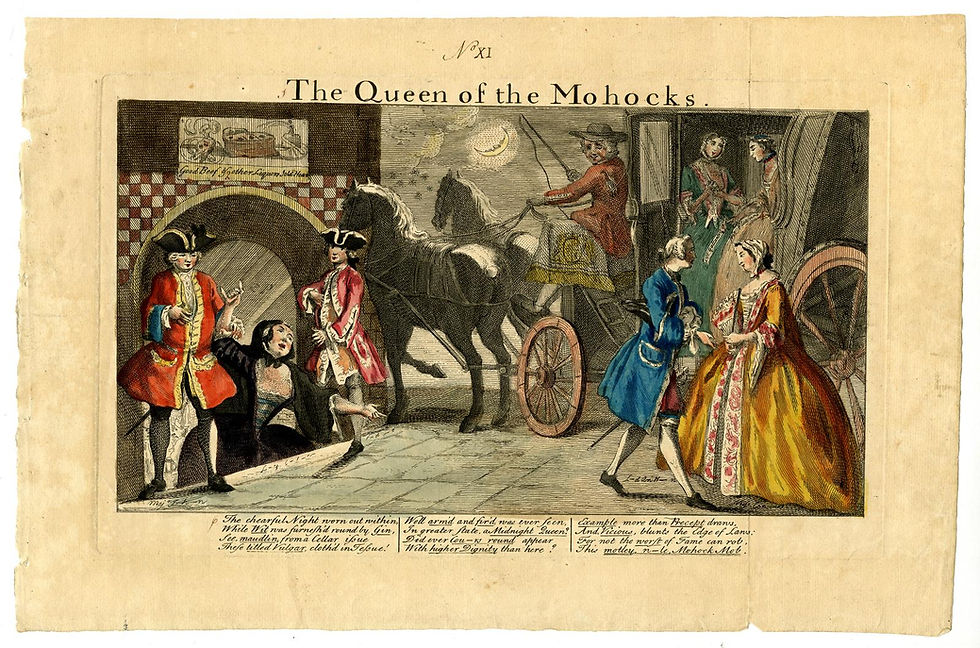
The Mohocks were described as a gang of violent upper-class men whose activities were concentrated in areas such as Covent Garden and Drury Lane, where the wealthy gathered for entertainment and drinking. According to contemporary accounts, these men roamed the streets after dark, attacking unsuspected pedestrians and transforming familiar urban spaces into sites of danger and uncertainty. The name itself was significant: ‘Mohock’ likely drew on contemporary associations with the Mohawk people of North America, whose reputation in the British imagination was shaped by racist narratives of ‘savage’ warfare and scalping. Such associations may have heightened the sense of brutality attached to the gang, amplifying fear through language as much as through acts.
Unlike the ‘Blackout Ripper’, the existence of the Mohocks remains uncertain, and their activities were likely exaggerated through early print culture. Pamphlets and satirical imagery, including figures such as ‘the Queen of the Mohocks,’ combined with sensationalised descriptions, contributed to the construction of a threatening and visible menace. This atmosphere of anxiety was not confined to printed reports alone but was also reflected in private writings. In A Journal to Stella, Jonathan Swift recorded the growing unease surrounding the Mohock attacks writing ‘Did I not tell you about the Mohocks that play devil about this town every night?’. Such observations suggest that fear of the Mohocks extended beyond print and into the conscious minds of the elite.
Similar anxieties appeared in the correspondence of Lady Stafford, an aristocratic observer of London society, whose letters captured the impact these reports had on everyday perception. She described an incident were ‘an old woman was put into a barrel and rolled down the hill by the Mohocks’, illustrating how the stories of violence circulated and intensified. Whether factual or exaggerated, such accounts reveal how the threat of violence was internalised, shaping how individuals navigated the urban environment. This climate of fear did not remain confined to pamphlets and private correspondence, but reshaped how Londoners moved through their city. Reports of nocturnal violence encouraged heightened caution, particularly after dark, as the streets were viewed as spaces of unpredictable danger due to the lack of street lights in Georgian England. Whether or not such threats were consistently real, the perception of risk was enough to alter behaviour, fostering vigilance and discouraging movement through certain areas. In this way, the circulation of Mohock narratives transformed the urban night into a contested and anxiety-laden environment.
This atmosphere of unease also aligned with the interests of authority. Concerns surrounding disorder and aristocratic violence prompted calls for greater regulation of urban life, particularly in spaces associated with drinking and late-night activity. The fear generated by the Mohock reports therefore provided justification for increased attention to policing and moral reform, reinforcing the need for a more controlled and surveyed city. As with later examples, fear operated on multiple levels: it encouraged individuals to regulate their own behaviour, while simultaneously legitimising greater oversight, ensuring that both informal self-policing and formal authority worked in tandem.
Another example of the media producing sensationalised narratives can be seen long after the alleged Mohock attacks in 1712 in the reports of the Blackout Ripper murders in 1942. These attacks primarily targeted women in London, many of whom were vulnerable due to the conditions of wartime life.

The man behind the killings was Gordon Cummins, a 28-year-old Royal Air Force (RAF) aircraftsman stationed in London during the Second World War. Cummins came from humble middle-class beginnings in North Yorkshire, and from a young age, he aspired to be a member of the aristocracy. This desire became all-consuming for him when he moved to London in 1930. There, he adopted an affected Oxford accent, wore tailored suits, and smoked expensive cigarettes. This constructed persona would later serve to deceive and gain the trust of the women he targeted.
Prior to the murders, he had perfected his aristocratic ruse, combining charm, glamour, and the strategic use of stolen money to secure female company. Yet while Cummins’ deception facilitated the crimes themselves, it was the subsequent media portrayal of the ‘Blackout Ripper’ that transformed the murders into a broader atmosphere of fear. By mid-February, as reports of mutilation and strangulation circulated, the figure of an anonymous killer became a powerful symbol of the dangers lurking with a darkened city. This image was quickly amplified by the press, with the Daily Mail insisting that Cummins was ‘the most notorious killer since Jack the Ripper.’ Similar comparisons were made elsewhere by the Sun newspaper, who described him as ‘London’s modern Jack the Ripper’, emphasising that the deaths of his victims ‘were strangely similar in manner and circumstance’. Newspapers did more than report crimes: they exaggerated them, portraying Gordon as a ‘sex maniac’, and transforming isolated acts of violence into a sustained atmosphere of fear in wartime London.
As in the case of the Mohock attacks, this climate of fear did not remain confined to newspaper columns, but reshaped how Londoners moved through their city. Women were urged to remain vigilant about the male company they kept, especially those in uniform; they were also discouraged from walking home at night alone from the West End. For many however, such precautions were impractical: factory workers and nurses had little choice but to navigate the city in darkness, adopting protective measures such as carrying a heavy torch or a whistle. These behaviours were shaped not only by fear of violence, but also the conditions of the blackout itself. With street lighting removed as part of the ‘Keep it Dark’ campaign (a wartime security measure), the familiar city was transformed into a disorienting landscape of shadows and uncertainty. This darkness intensified public anxiety whilst also fostering a light discipline in which even a slither of light through a curtain could prompt a neighbour to yell ‘put that light out’. In this way the blackout environment and the circulation of fear worked in tandem, encouraging vigilance, suspicion, and self-regulation of everyday behaviour.
The state, in turn, benefitted from the atmosphere of fear and used it to enforce social control. This operated, in part, through the management of information, as the authorities encouraged the press to temper the Ripper murders amid concerns that mass hysteria would damage morale and hinder the war effort. At the same time, this climate of heightened anxiety justified an increased police presence across the city, particularly in areas associated with the attacks. In this way fear functioned on multiple levels: it encouraged civilians to regulate their own behaviour, ensuring that both informal self-policing and formal authority worked in tandem.
In this context the wartime body became subject to a form of indirect governance. While the state could not physically monitor every individual, it cultivated conditions in which behaviour was shaped from within. Through the management of information, the enforcement of blackout conditions, and the circulation of fear, civilians were encouraged to regulate their own movements, interactions, and habits. The result was a population that operated within boundaries that had been carefully constructed, where limits of acceptable behaviour were both externally imposed and internally maintained. In doing so it revealed a powerful truth: the most effective forms of control are not those imposed upon the body, but those that are absorbed and enacted by it.
On a darkened street, whether in 1712 or 1942, fear proved capable of travelling further than any individual threat. It moved through print, conversation, and perception, embedding itself within the rhythms of everyday life. The cases of the Mohocks and the Blackout Ripper reveal that such fear was never confined to the crimes themselves. Instead, it reshaped how individuals understood their surroundings, encouraging vigilance, restricting movement, and fostering a culture of self-regulation. In both instances, the boundary between real and perceived danger became increasingly blurred, yet the behavioural consequences remained strikingly tangible.
Crucially, these climates of anxiety did not exist in opposition to authority, but often operated in alignment with it. Whether through the amplification of threat or the management of information, fear became a mechanism through which order could be maintained, justifying increased oversight, while encouraging individuals to regulate their own behaviour. In this way, the regulation of society did not rely solely on visible enforcement, but on something far less tangible. It depended on the internalisation of fear itself. The state did not need to physically restrain the body when the body, shaped by anxiety, learned to restrain itself. If fear can so effectively govern behaviour, then to what extent are the limits of our own movement truly our own?
Further Reading:
James Osbourne, “WW2’s ‘Blackout Ripper’: How a Respected War Hero Manipulated the Blitz and Became a Serial Killer,” History Extra, 4 November 2025 <https://tinyurl.com/4fwjwjpw> [accessed April 15, 2026].
Simon Read, In the Dark: The True Story of the Blackout Ripper (Berkley Publishing Group, 2006).
Simon Read, The Blackout Murders: The Shocking True Story (JR Books Ltd, 2008.)
Neil R Storey, The Blackout Murders: Homicide in WW2 (Pen & Sword True Crime, 2023).
Stephen Wynn, The Blackout Ripper: A Serial Killer in London 1942 (Pen & Sword True Crime, 2022).
Sophie Riley is a history writer specialising in twentieth-century Europe and the interrogation of historical myth. Her work focuses on figures such as Witold Pilecki, whose experiences complicate dominant narratives of the Second World War. She is the creator of Soph’s History Corner on Substack and shares her work on LinkedIn, where she examines overlooked histories and reconsiders widely held historical assumptions.


