


The Expulsion and Erasure of Hans J. Reissner

Daniel Evans │ Durham University

The Third Reich stole his home, devastated his family and as a final insult, its dead hand reached out through history to erase his accomplishments. Hans J. Reissner can be credited with numerous significant contributions to the fields of engineering, aeronautics, mathematics, and physics. However, as a victim of Nazi persecution, he has been anonymised and disregarded ever since. The cultural historian Rüdiger Haude first highlighted a process of ‘sustained erasure’ with regards to Reissner, calling the lack of proper recognition for him ‘striking’.
To me, Hans Reissner is not just a figure of historic or scientific interest. He is my great-great-grandfather; the man who taught my grandfather to swim off the Welsh coast and ensured he had his first proper bicycle. While I will cover this personal element and the insight it provides, I will allow his achievements to speak for themselves. My goal is to open a window into his life and experiences which has not been opened before.

Flight
In the early morning sun, I wander across the Brander Heide. The morning awakens dewy. In the nearby woods, the horn players and drummers are practicing. These impressions remain indelible and repeatedly awaken old enthusiasm. A primitive shed at the edge of the woods housed the object of my longing: Professor Reissner's flying machine. A true 'machine', full of struts and wires and spars and bracing and stiffeners. Confusing, complicated, warped and distorted, it stood there and let the day come to it, when endless re-tensioning and altering should finally persuade it to leave the ground - From the memories of Offerman, Hans Reissner’s assistant in Aachen.
On 21 April 1909, this mass of struts, wires and spars would take to the air for the first time. It’s pilot, Professor Hans Reissner, ascended five meters into the spring air and after a flight of forty meters, brought the craft carefully back to earth. This was not the first manned flight in Germany, or indeed the world, but this work on the Aachen Brander Heide was pioneering.

Writing in 1963, Professor Alexander Naumann argued that Hans J. Reissner ‘was one of the first to approach problems of aerodynamics with scientific means’. In 2007, Rudiger Haude similarly wrote that he was a lone avant-gardist of aviation technology in a time often characterised by a more swashbuckling intuition. His theory-driven, professionalised approach was an important and essential evolution within the development of flight technology.
Alongside this, Reissner can be credited with numerous key innovations. He designed the first all metal plane to fly, the first controllable pitch propellors used in flight and made numerous valuable contributions to propellor theory. In 1920, he was recognised in the Zeitschrift für Flugtechnik und Motorluftschiffahrt (Journal for Aeronautics and Motor Airship Travel) as the 'father of aircraft statics'. and similarly in the Dutch Het Vliegveld (The Airport/ The Airfield) as its 'founder'. It was Reissner who brought Hugo Junkers into the field of aviation in 1908, beginning a productive partnership that led to the founding of the Aachen Aeronautics Institute, the construction of its first wind tunnel, and Junkers pursuing the aeroplane construction for which he is best known today.
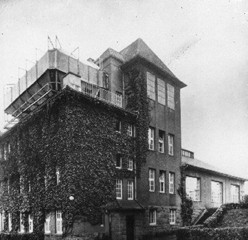
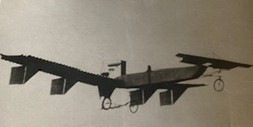

Left: A photo of the Aachen aeronautics Institute. (Credit: Caltech Archives and Special Collections). Centre: The Reissner Canard in flight at Johannisthal, 1912. (Credit: Family Photo). Right: Hans Reissner next to one of his planes. (Credit: Family Photo).
Not content with isolating himself merely to the role of aviation pioneer, Hans turned his attention to theoretical physics. In a letter to Albert Einstein in 1915, he described his attempts to enter ‘the magnificent building’ of his theory of General relativity and in 1916 these efforts bore fruit with the publication of Über die Eigengravitation des electrischen Feldes nach der Einsteinschen Theorie (On the Self-Gravitation of the Electric Field According to Einstein's Theory). In this work, Hans provided the first solution for how gravity acts around an electromagnetically charged, non-rotating, point mass. It was also the second ever solution to the Einstein-Maxwell field equations, following Karl Schwarzchild who had published a paper earlier the same year. Now known as the Reissner-Nordström metric, these results were later co-discovered by Hermann Weyl, Gunnar Nordström, and George Barker Jeffery and remain relevant for theoretical physicists to this day.

By 1933, Reissner was a distinguished professor at the prestigious Berlin Technische Hochschule (BTH), Chairman of the German Aircraft Committee, Vice President and co-founder of the Society for Applied Mathematics and Mechanics (GAMM), and the holder of an Iron Cross 2nd Class for civilians which had been awarded during the First World War. He was living comfortably in his home city of Berlin and had built a large family with his wife Josephine. Just over three years later, they were fleeing for their lives across the Atlantic.

Expulsion
In almost all areas of technical mechanics, we owe him ground breaking work (…). A large number of ideas that have significantly promoted the development of flight technology in Germany can be traced back to him.... His colleagues and numerous students, who value Reissner, as much as a distinguished person as a scientist, will remember him on his birthday with respect and sincere affection - 60th birthday dedication for Hans in January 1934, from his friend and colleague Erich Trefftz.
Trefftz’s words are warm and sincere, but they were written in the midst of an increasingly suffocating nightmare for German-Jews. His respect and affection should not necessarily be doubted, but this was a nightmare that Trefftz had nominally condoned by signing allegiance to Hitler in November 1933. Professor Wilhelm Roepke penned a scathing criticism of his fellow academics, describing a ‘scene of prostitution’ towards the regime that stained the halls of German learning. A friend Trefftz may have been, indeed one who spoke out against the exclusion of Jews. Even so, when push came to shove, he signed away his principles to preserve his career. Roepke’s words are harsh, but they are not inaccurate. The prevailing mood was not one of solidarity, but triumphant approval and intimidated silence.
Even before 1934, the environment had become intensely hostile. Smoke from the Reichstag fire settled over Berlin and gangs of Nazi thugs reaved on the city’s streets. Workplaces, streets, parks and schools became areas of intimidation and exclusion. Hans and Josephine’s daughter Dorothea later recalled how friends at school began to ignore her and their son Edgar, who had harboured a strong desire to become a naval officer, was forced from the Academy at Mürwik. Under the Nuremburg Laws, if an individual had three Jewish grandparents or two and a Jewish spouse, they were immediately rendered Untermensch - a sub-human outsider in their own country. Both Hans and Josephine were Jewish on both sides, so they and all their children found themselves squarely in the Nazi crosshairs. By the end of 1934, Dorothea and Edgar had been sent away from Germany for their own safety, with their elder brother Eric following not long after. The Reissner’s home had contorted before their eyes at bewildering speed, and it was not long before they all left it behind for good.
The BTH, the institution Hans first entered as a young man, provided no sanctuary. The 1930/31 student elections saw Nazi candidates take twenty of the thirty seats and shock brigades of fanatical students roamed the corridors, blocking the lecture halls of Jewish professors. Hans now walked with papers to his chest to avoid performing the fascist salute, but this small act of defiance was made in the eye of a raging storm.
His possession of an Iron Cross, a prior conversion to Lutheranism, and the fact he had held a civil service rank for decades insulated him from the initial purges of 1933. On the other hand, those who had survived those early expulsions often faced ever more rabid scrutiny. The situation was terminal, and in late January 1935 the Nuremburg laws forced him from the University.
Erasure
When writing about his life, Eric Reissner described how his migration to the United States had been prompted by the ‘unpromising political situation’ in Germany. Eric, who feared repeated persecution, actively hid his heritage, so his understatement here is quite understandable.
What is altogether less acceptable is the subtle diminishing of the persecution faced by the family in other sources. In Hans Ebner’s 1967 obituary, he wrote that Hans Reissner was ‘retired in connection with the political situation’. To use the term ‘retired’ is to adopt the language of the Nuremburg laws and softens what was a violent expulsion founded in intense racism. In many sources terms such as ‘migration’ are repeatedly used and in others the story is warped entirely. The 75th Anniversary Volume of Hans Reissner’s works records him leaving his native land due to the Nazis discarding ‘the principles and ideals’ of the old Germany. If by principles and ideals, they meant his right to life, then this would be true, but it once again diminishes the extent of the Nazi threat.

This was not ‘emigration’, ‘retirement’, or founded primarily on political disagreement. The simple fact remains that the Reissner family were forced from their home entirely against their will by a regime that would have killed them had they stayed. Though Ebner and the Anniversary Volume certainly had good intentions, the vague, brief acknowledgment and incorrect framing of the story should be corrected.
Hans and Josephine Reissner arrived in New York in late 1937. They left behind their home, familial community, friends, and their daughter Eva who had tragically passed away in February. Their remaining children were separated from them, with Eric the only one in the United States at that time. Dorothea was staying with her aunt in Switzerland and Edgar was living in London. By the end of the war, two of Hans’ brothers, Walter and William, had been killed by the Nazis, and his wider familial community had been decimated. Cousins who had once paid visits to their home in Berlin had been murdered in the camps and those that remained were scattered across the world.

As a final insult, the Third Reich’s influence on the history of German science has erased his significance. Though Hans features regularly, this is often as a helper or inspiration to more famous names. In Richard Blunck’s 1940 biography of Hugo Junkers he appears extensively but is anonymised as an ‘assistant’. Hans Vogt similarly obscured him as an unnamed ‘Aachen colleague’. This general air of disrespect is perhaps down to Hans being largely unable or perhaps unwilling to assert his place. On the other hand, Lutz Budrass’ assessment, that the Nazis have exerted a long-lasting influence on the history of German aviation, is a compelling one. If the antecedent works that many have relied upon are built on lies and omittance, it will take time for a proper re-assessment to correct these errors.
There has been a degree of rehabilitation. In 1954, he was elected as an honorary member of the reconstituted German Aeronautics Society and in 1955, the BTH made him an honorary senator. Such minor consolations can hardly begin to undo the damage done and it should be noted that many of the rabidly antisemitic professors who had rejoiced at the humiliation of their colleagues faced little to no lasting repercussions.
Hans J. Reissner is but one island in the vast archipelago of stories that make up the Holocaust. He should not be defined by the persecution he experienced, but it would be a disservice to believe that ignoring this central aspect of his history, one that erased his legacy, does him any justice. That a nation can so rapidly turn on its own with such violence is an important lesson for us all to heed.
Further Reading:
Hans Ebert, ‘The Expulsion of the Jews from the Berlin-Charlottenburg Technische Hochschule’, Yearbook - Leo Baeck Institute, 19/1 (1974), pp. 155–171.
Rüdiger Haude, Grenzflüge, Politische Symbolik der Luftfahrt vor dem Ersten Weltkrieg. Das Beispiel Aachen (Böhlau Verlag, 2007).
Egon Krause, ‘The Reissner Canard: The first all-metal airplane 100 years ago’, Progress in aerospace sciences, 54 (2012), pp. 59–64.
Mark G. Pegg and Marion A. Kaplan, Jewish Daily Life in Germany, 1618-1945 (Oxford University Press, 2005).
Reinhard Siegmund-Schultze, Mathematicians fleeing from Nazi Germany: Individual fates and global impact (Princeton University Press, 2009).
The Staff of the Department of Aeronautical Engineering and Applied Mechanics of the Polytechnic Institute of Brooklyn, Ed. Reissner Anniversary Volume: Contributions to Applied Mechanics (Michigan, 1949).
Daniel Evans recently completed a master's degree in history at Durham University. His current research interests include Jewish Berlin, the collapse of German Democracy, and generational memory transition.


