


Nun Too Soon – Recovering Victorian Convent Histories

Heather Glover │ University of Lincoln
Where I grew up in the English Midlands, it is not entirely unusual to see friars and religious sisters travelling by train between major cities like Coventry and Leicester. But the inhabitants of Britain’s monasteries and convents are far less visible than they are in neighbouring Roman Catholic countries like the Republic of Ireland and France. It is therefore not surprising that the histories and archives of these communities are not particularly popular subjects of study, except to those with a strong interest in church history. But nuns in particular play an important role in our popular imagination, appearing as kind and funny figures in films like The Sound and Music and Sister Act. So, who are the real women who inspire these kinds of characters and stories?
In sixteenth-century England, the Tudor King Henry VIII established the Church of England and dissolved the medieval Roman Catholic monasteries. His followers seized their land, buildings, and possessions for the state. The suppression of the ecclesiastical houses, combined with the penal laws which targeted those who practiced the Roman Catholic tradition, which carried on through the reigns of Edward VI, Mary I, and Elizabeth I meant there were no Roman Catholic Convents in Britain until the nineteenth century. This period saw both the beginning of Catholic Emancipation - allowing for the return of religious orders to the British Isles - and a period of concern for the education and wellbeing of the poor in England’s newly industrialised cities.
These factors encouraged the founding of new convents, where communities of women worshipped and prayed together, as well as supporting their neighbours through their teaching, nursing, and other social work. Research on nineteenth-century convents tends to highlight the charitable work of these women, as evidence of their wider impact on society. Our perspective tends to be that of an outsider looking in: we focus on what these nuns did outside the cloister, rather than on their lives behind closed doors.
The archives of modern convents can lift the veil, allowing us to recover the voices and experiences of women living in these communities. The collections of Stone Dominican Convent, Stoke-on-Trent, are a good example: their collections include books, letters, notebooks, paintings, music scores, and other materials made by the nuns themselves. From complex theological works to caricatures on postcards, these resources bring to life the inspiration, variety, challenge, and humour of the convent, which offered nineteenth-century women an alternative path to marriage or ‘spinsterhood’ – a stigmatising term used to describe unmarried women. Through these collections, we get a glimpse into the creativity and intellectual endeavour they cultivated together in a time when few universities allowed female students.

Why haven’t researchers jumped on this rich material? Lack of access and awareness pose significant barriers between scholars and the archives of convents like Stone. If you search for Stone’s materials on the National Archives website, a useful database of archives across the UK, it will tell you that they are held at the convent itself in Stoke-on-Trent. A quick Google search will, however, inform you that the old convent buildings are currently being transformed into a care home. Stone Dominican Convent closed in 2023, with the remaining sisters joining other branches of the English Dominican Congregation.
What happens to a community’s history – preserved in its archives – when it no longer exists? This is a challenge faced by convents more widely, as decreasing numbers of new members makes it difficult for them to continue their missions of prayer and service. As numbers dwindle, their historic collections are put at risk. On the closure of a convent, its materials pass to the Mother House from which it was founded, maintaining ownership. In the case of Stone, however, the Mother House in Stroud lacked the space and resource to store and care for the extensive collections. The sisters therefore approached the Birmingham Archdiocesan Archives – a central Roman Catholic library attached to St Chad’s Cathedral – who offered to house the books, manuscripts, and ephemera of the Stone Dominican sisters, in recognition of the material’s historic significance.

My own work with the Stone Convent archives began when I became interested in the histories and poetry published by one Victorian sister, Augusta Theodosia Drane (Sister Francis Raphael). Drane was a talented researcher and writer; the depth of her study and beauty of language drew me in, leaving me wanting to understand her better. Luckily for me, Drane left substantial collections of personal material in the care of her religious community. I contacted the convent’s archivist some years ago, before the closure, only to learn that their archives were being relocated and were therefore unavailable. A year later, I reached out again and learned that the Stone collections had found a new home in the Birmingham Archdiocesan Archives, which back on to St Chad’s Catholic Cathedral. The librarian sent me a handlist of the material related to Drane and I realized that I had found a major project. I secured funding for a series of trips, began requesting material, and booked an early morning train. In October 2024, I arrived for my first deep-dive into the records of this woman’s life.

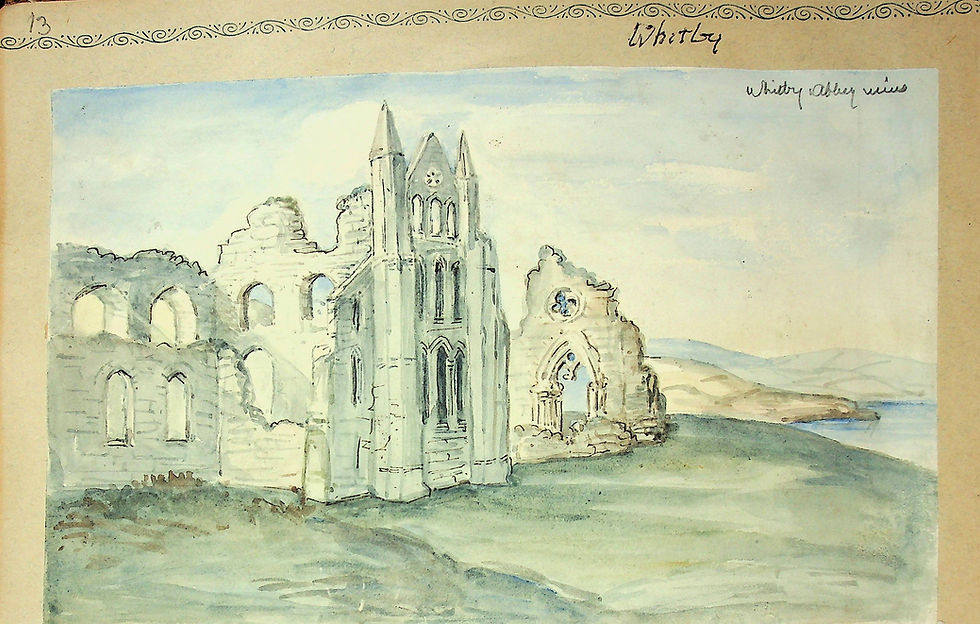
The Drane collections include her personal copies of the books she printed, including histories, novels, spiritual treatises, and her poetry anthology ‘Songs in the Night’. Some of these contain her personal annotations, as well as pictures and newspaper cuttings she pasted inside. One newspaper cutting describes Drane as a ‘distinguished Catholic author’: she has crossed this out and scribbled “me” instead. There is a mass of letters sent by and to Drane, including from the influential Victorian churchman, John Henry Newman. All of these letters are now available online through the Newman Studies Digital Collections. There are plays written for school children, musical scores for hymns, and personal notebooks containing Drane’s research notes and reflections. The collection also includes beautifully illuminated poems produced by Drane and a book of her watercolour paintings, depicting scenes of ruins and natural landscapes from her travels through England and Italy.
Becoming a religious sister means making a life-changing commitment to follow the rule of your Order and to live in community. As a Dominican nun, Drane’s particular calling was to study and teach the Roman Catholic religion, to serve her community, to pray and to worship. This calling was all encompassing, shaping the meaning and importance of everything she did. Reflecting on the Dominican women she had studied and on her own experience, Drane therefore wrote that ‘the religious women of the Order have[…] laboured to save souls ‘any-how,’ and it was all one whether the work was to be on paper or on canvas, in the school, the hospital, the prison, or the homes of the poor’. The diversity of Drane’s archival materials demonstrates how she used every possible means to explore her faith, her heritage, and her vocation, putting her ‘intellectual and artistic powers in the service of God’.

Despite – and perhaps because of – the seriousness of this commitment, the nineteenth-century sisters at Stone found ways to laugh at themselves and each other. My favourite sequence of postcards in the collection shows Drane and the Mother Superior being chased from a beach by cows whilst attempting a spiritual retreat. A painting by Drane depicts her and her sisters doodling and scribbling on a big sheet of paper, whilst other nuns doze at their knitting and bury themselves in books. In a comic poem written for a celebration in her community, Drane presents herself as a grumpy Jerome, writing away whilst her sisters patiently support her through each project. Three years deep into my own doctoral research, I see bits of myself echoed in this Victorian woman, and her dry humour reminds me not to take myself too seriously.
At the same time, I wonder whether Drane was sometimes using humour to mask a deeper point about the gender expectations of her time. The comparison to Jerome is a significant one. Jerome translated the Bible into Latin, creating the Vulgate Bible, versions of which have been used by the Catholic church for nearly two thousand years. Drane affirms that she, like Jerome, is a historian, translator, and biblical scholar, whose works offer a valuable contribution to the Catholic Church. Given women’s historic exclusion from leadership positions within many Christian denominations, there’s something quite radical about the life and work of this Victorian nun.
What next for the Stone convent archives? I hope that my work will encourage more interest in the world of these religious women and that more researchers will access their collections, particularly once they have been added to the digital catalogue of the Birmingham Archdiocesan Archives. As convents close, we risk losing track of their rich archival resources and their oral traditions, which combined give us important insight into their religious, intellectual, artistic, and social lives. We need archivists, researchers, church leaders, and religious women to work together to safeguard their heritage for the future. This work has begun in the case of the Stone collections, and it is – if you’ll excuse the pun – happening ‘nun’ too soon.
Acknowledgements:
I am grateful to the Bibliographical Society for funding this project and to the Birmingham Archdiocesan Archives for facilitating my research. I am also thankful to the archivist for her suggestions on this piece and for granting me permission to publish images of the Drane collections.
Further Reading:
Timothy Brittain-Catlin, 19th- and 20th-Century Convents and Monasteries: Introduction to Heritage Assets, ed Paul Stamper (English Heritage, 2014).
Augusta Theodosia Drane, Songs in the Night (Burns & Oates, 1876).
Augusta Theodosia Drane, The Spirit of the Dominican Order (R & T Washbourne, 1910).
Anselm Nye, A Peculiar King of Mission: The English Dominican Sisters, 1845-2010 (Gracewing, 2010).
Digital Resources:
Heather Glover (BA Oxon; MPhil Cantab) is a Graduate Teaching Fellow and doctoral researcher at the University of Lincoln. Her research examines nineteenth and early twentieth century engagement with medieval devotional writing, as evidenced by both literary and visual sources. This includes studying medieval and modern monastic communities. She is interested in the connections between book history, religion, and creativity.


