


Brothers at War: How Mughal Inheritance Shaped a Dynasty’s Destruction

Khadija Tauseef │Government College Lahore
The rattle of chains reverberated through the marble halls, each step casting a hush across the court. Courtiers held their breath as two guards emerged from the shadowy corridor underneath the Jharoka, where the king sat. Behind them was a prisoner who lurched forward due to the strain of the iron shackles that bit into his skin. The young man was barefoot, wearing tattered clothes, and looked as if he had not bathed for days. It took a moment for those around him to recognise him. Prince Dara Shikoh. In place of the scholar-prince once hailed as the jewel of the Mughal court now stood a broken figure, a shadow of his former self. A prisoner of war, but not in a foreign land; this was his ancestral empire. Where he had once roamed free and practiced philosophy, dressed in silks and jewels.

Although civil war wasn’t uncommon, the 1657 War of Succession was a turning point in the Mughal Empire’s history. The main protagonists of this struggle were four brothers: Dara Shikoh, Shah Shuja, Murad Baksh, and Aurangzeb Alamgir. However, a question arises as to why four brothers would fight against one another. Was it merely power-hungry princes trying to seize the throne, or is there more to it? The truth behind Dara’s chains dates back centuries, to the windswept steppes of Central Asia, where kingship was never inherited but seized.

The uniqueness of the Mughal succession system is often overlooked by historians, who frequently view it as an anomaly in contrast to the stricter inheritance customs of nearby kingdoms. However, the Mughals were by no means the only ones to adopt adaptable, or brutal, methods of royal succession. The Ottomans institutionalized fratricide because of their common steppe ancestry, enabling a victorious prince to kill his brothers to avert further unrest. In East Asia, China and Korea maintained Confucian principles of orderly inheritance, while Japan balanced ancestry with merit and divine favour, allowing for political scheming. But even in China, emperors sometimes chose a more qualified applicant over the oldest son.
When combined, these instances show that civil war was a possibility even in systems based on strict primogeniture. When weak rulers inherit the throne or when ambitious princes reject a present hierarchy, primogeniture breaks down. Therefore, one must first comprehend the Mughals’ origins.
The Mughals’ idea of succession originated from a tradition that was essentially distinct from European primogeniture, and they traced their ancestry back to the Timurids and Mongols. The Mongols did not inherit power; rather, it was acquired via conquest, alliances, and individual merit. This idea was ingrained in Genghis Khan’s Yassa, the unwritten code created circa 1206, which taught that a prince demonstrated his value through bravery, winning, and fostering loyalty, the fundamental tenet of ‘Might is right’.
Timur, a Turkic-Mongol conqueror, forged his empire in the fourteenth century, tracing his ancestry proudly to Genghis Khan. Around the late 1370s, Timur fused the Mongol ‘right of conquest’ with Islamic theology. Timur would publicly claim that his victories in battle were seen as a sign of divine favour, not merely proof of strength. After Timur’s death, those who seized the throne thus did so by the sword and by the sanction of God.

More than a century later, his descendant Zahir-ud-Din Muhammad Babur, the founder of the Mughal Empire, would carry that legacy eastward. Born in 1483 in a small Timurid principality of Andijan, in the Fergana Valley of modern-day Uzbekistan, Babur inherited that same fusion of conquest and faith. For him, all male relatives were competitors; every brother, cousin, or uncle was a threat to his throne. In the world of his ancestors, royal blood was both a blessing and a curse.
Babur inherited his father’s fragile throne at the tender age of twelve. He was confronted by threats from his uncles and cousins, who believed that they had an equal right to the throne. In his memoir, the Babur Nama (1494-1530), Babur mentions the dangerous world in which he was born: one in which kingship was never inherited but taken by force. A result of such competition was that Babur was eventually driven out of Andijan. He made his way to Kabul, where he rebuilt his forces and then turned his sights on India.
In 1526, Babur established himself in India. He brought with him not just an army but an idea: that rule was earned through merit and destiny, not by birth order. Babur was proud of his origins, and even future emperors would often recall their heritage. However, he did make some changes to prevent further fratricide; he limited succession to his sons, excluding other male relatives. While the change may have been minor, it made all future princes both heir and enemy.
Humayun took the throne in 1530, after his father Babur’s untimely death. He was surrounded by ambitious brothers and rebellious nobles. His brothers, Kamran and Askari, believed themselves more worthy, and Babur’s disillusionment with Humayun’s abilities didn’t help. As a result, Humayun spent half his reign in exile, wandering Persia and gathering forces to reclaim his throne. Before he could consolidate his rule Humayun passed away after falling down his library stairs, leaving his thirteen-year-old son, Akbar, to inherit an insecure throne.
Akbar inherited a throne with no immediate challenges; thus, his reign promised a rare reprieve from the chaos of his forefathers. He had a half-brother, Mirza Hakim, who was ten years his junior and ruled Kabul under Akbar’s nominal authority. He tolerated Hakim’s independence until the prince rebelled. It showed that even distant kin could become rivals, especially since they were both Humayun’s sons.
However, Akbar did not just face problems simply from his half-brother, but also from his three sons: Salim (later Jahangir), Murad, and Daniyal. Akbar used to encourage his sons to cultivate influence at court. As historian Munis D. Faruqui indicates, since birth, Mughal princes were designed to be active political figures in a fierce competition for their father’s favour. The Mughal court cheered this rivalry on, believing that such conflict would expose the strongest heir. But this approach turned every family bond into potential conflict. As a terse Persian phrase puts it, ‘ya takht, ya takhta’ – ‘either throne or funeral bier’.
Some chronicles whisper of a moment during Akbar’s reign, when he fell gravely ill and his sons started utilising their armies to fight for the throne. However, Akbar’s quick recovery delayed the inevitable. Whether myth or memory, it captures a deeper truth: even a ruler famed for tolerance and intellect, the empire’s foundation remained fear. Unfortunately, Akbar lost two of his sons, Murad and Daniyal, to alcohol poisoning, and because of that, he feared that his son, Salim, didn’t have the temperament to be emperor. As a precaution, Akbar began training his grandson, Khusrau (Jahangir’s eldest son), for the throne. However, as he approached his end, he decided to let destiny prove who was worthy of the throne.
In 1605, Jahangir ascended the throne. He mentions this moment in his memoirs: ‘By the grace of the Almighty, the throne which from the beginning had been destined for me came to me without strife’. This line seems ironic because Jahangir’s own life was shaped by rebellion. First, when Jahangir rebelled against Akbar, and later his son Khusrau rose against him. Jahangir crushed Khusrau’s rebellion, and as punishment, he blinded his son but spared his life. This mercy was rare, but like his father, Akbar, who had spared Mirza Hakim, Jahangir followed his example and forgave his son. Later, during his reign, when Jahangir had become more reliant upon drugs and drinking, two main factions were vying for control. Nur Jahan, Jahangir’s last and most powerful consort, and Khurram (later Shah Jahan), Jahangir’s favoured son.
Prince Khurram openly rebelled against his father, Jahangir, around 1622, largely out of fear of being sidelined by Nur Jahan and his younger brother Shahryar. He was defeated and forced to submit. When Jahangir died late in 1627, Nur Jahan tried to place Shahryar on the throne. Khurram, backed by his father-in-law Asaf Khan, however, moved quickly, secured the empire in early 1628, and had Shahryar and several other male rivals executed.
Khurram took the name Shah Jahan upon ascending the throne. Under his rule, the Mughal Empire reached its zenith of beauty and grandeur. Yet, within the glittering court, affection had become hierarchy. Shah Jahan’s open devotion for his two eldest children, Dara Shikoh and Jahanara Begum, created an atmosphere of rivalry among his other children. Shah Jahan’s other sons, Murad, Shuja and Aurangzeb, would try their best to impress their father.

Unfortunately, no conquest, no victory, was ever enough to equal Dara’s effortless brilliance at court. So, his sons grew up knowing that they were loved less. Historian Munis D. Faruqui observes that Mughal princes lived under constant ‘psychological uncertainty’, and their very survival depended not on birthright but on their ability to outmanoeuvre their male relatives through personal merit, military strength, and political alliances.
Initially, the sons believed that as long as they remained loyal and kept gaining merit, their father would eventually recognise their talents. However, that changed when a letter arrived for Aurangzeb from his sister Roshanara. She warned him that their father, along with Jahanara and Dara, was planning to assassinate him. He had become a threat to Dara, and so he could be eliminated to protect Dara’s claim. This turned jealousy and envy into resentment, because now the other children knew that they were expendable if it meant that Dara’s future was secure.
Shah Jahan ascended the throne after spilling the blood of his brothers, cousins, and nephews. This set a bloody precedent, showing his sons that only those favoured by their father would survive. However, Shah Jahan constantly favoured his eldest, causing conflict with his other sons, who still hoped for their father's recognition. That hope was shattered when Shah Jahan, with the approval of Dara and Jahanara, was prepared to kill Aurangzeb, whom they considered a threat. While the Mughal succession system may seem harsh, it offered each son equal rights and opportunities.
When Shah Jahan fell gravely ill in 1657, rumours coursed through the court that he would not survive. News of the emperor’s supposedly terminal condition unleashed long-suppressed ambitions: within weeks, all four princes, Dara Shikoh, Shah Shuja, Murad Baksh, and Aurangzeb Alamgir-were preparing for war. Knowing their lives hung in the balance, they all marched with their armies.
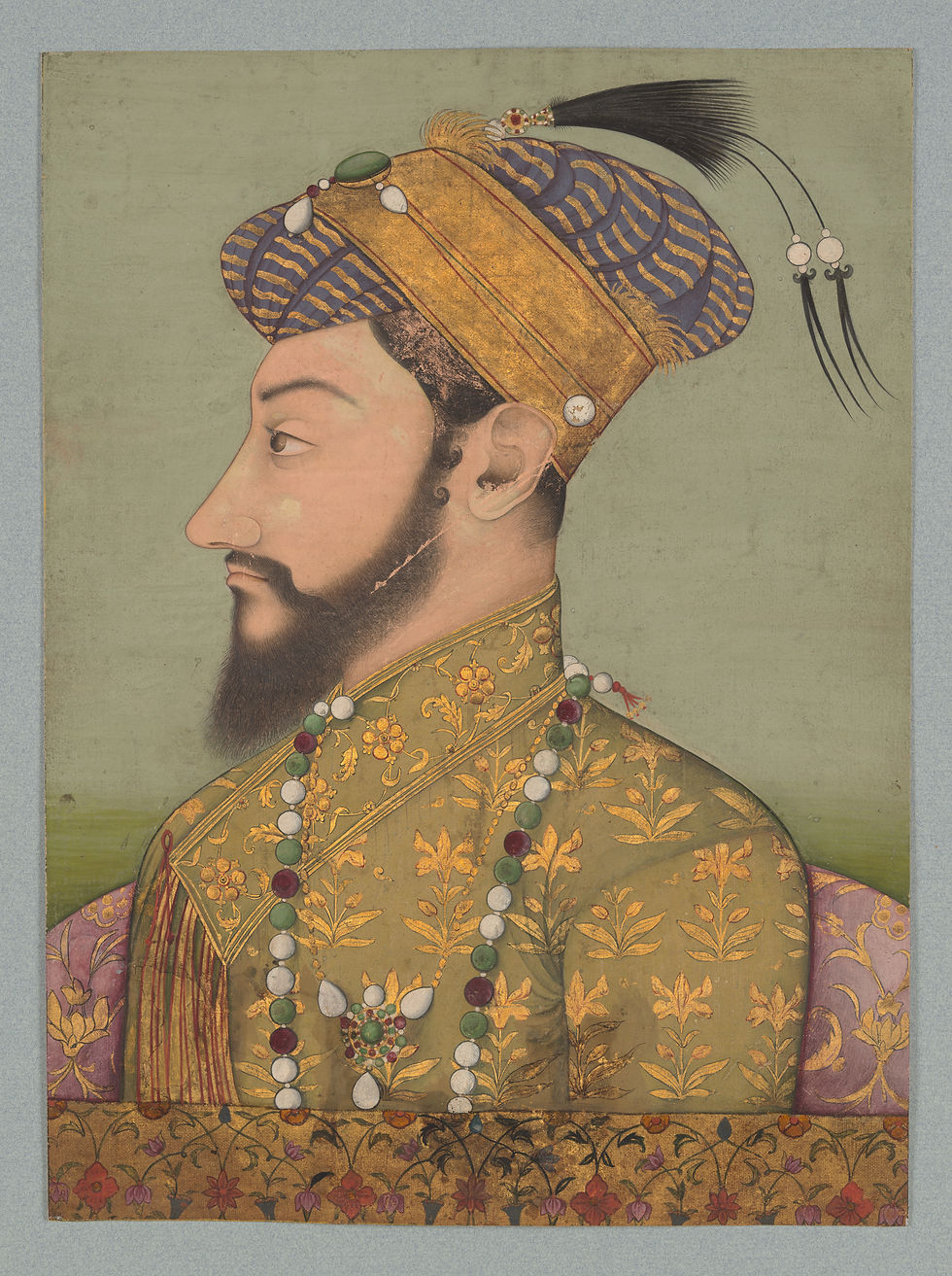
Shah Jahan had long intended for Dara to succeed him, showering him with honours and entrusting him with state affairs, yet he never formally proclaimed him heir apparent. His other sons, posted as governors in distant provinces, Shuja in Bengal, Murad in Gujarat, and Aurangzeb in the Deccan, saw both their exclusion from court and their father’s silence as an opportunity. Each believed he might still win imperial favour by force.
The War of Succession moved fast and showed no mercy. Shuja and Murad barely put up a fight before being pushed aside. Dara had the imperial army and his father’s support, but that didn’t save him. He went up against battle-hardened Aurangzeb, whose soldiers didn’t flinch. In the end, Dara’s poor choices and unreliable friends brought him down. Aurangzeb took the throne, as fate had picked him out from the start.
Our history teaches us not only who our ancestors were but also provides a window into the world and systems that shaped their lives. Mughal history often blames the empire’s eventual collapse on this very moment, the War of Succession. However, there is more to the reality of the empire’s decline. After all, this wasn’t just family drama. This was the last echo of an old law, one older and deeper than ever the Mughal dynasty. Yet few historians examine this deeper issue, the very succession system that made the Mughals unique, also sowed the seeds for their destruction.
But then the first great war over the throne shattered any image of the Mughals as untouchable. The same system that once gave them powerful rulers started to eat itself alive, ripping apart the family at its core. When Aurangzeb died in 1707, his sons just kept the cycle going, throwing the empire right back into chaos. Many history books oversimplify the narratives, blaming the downfall on a singular individual, vilifying him. When the real issue is the system itself, it guarantees conflict to ensure the best candidate takes power.
By comparing the Mughals with other empires, it is clear that the Mughals were not an exception, but part of a larger story of how empires struggled with the question of who should rule. Ultimately, the Mughal world, built on talent and sheer force, sometimes lifted them, sometimes tore everything down. In the end, the Mughal empire fulfilled its tragic design: ‘a dynasty destined for greatness, but never for peace’.
Further Reading:
Annette Susannah Beveridge, ed., Bābur-nāma: Memoirs of Babur (Sang-e-Meel Publications, 2002).
Munis D. Faruqui, The Princes of the Mughal Empire, 1504–1719 (Cambridge University Press, 2012).
Supriya Gandhi, The Emperor Who Never Was: Dara Shukoh in Mughal India (Belknap Press, 2020).
Khadija Tauseef completed her MPhil in History with a specialisation in Mughal History. Her passion for history drives her to continually expand her knowledge of various historical periods, deepening her understanding of the ancient world. She began her writing journey in 2020 and has contributed to multiple magazines and websites over the years.


